

If you wake up with your eyelids stuck together, your eyes feel gritty like sand, or your eyelashes are crusted with flakes, you’re not alone. About 47% of people who visit an eye doctor have blepharitis - a chronic inflammation of the eyelid margins. It’s not contagious. It won’t blind you. But it can make every day feel like your eyes are fighting a slow, annoying battle. And the good news? The most effective treatment isn’t a prescription. It’s something you can do at home, every morning, in under 20 minutes: a warm compress.
What Blepharitis Really Feels Like
Blepharitis isn’t just redness. It’s a persistent, low-grade irritation that builds up overnight. You might notice crusty flakes at the base of your lashes when you blink. Your eyes may burn or water without reason. Some people describe it as having a “foreign body” in their eye - like a speck of dust that won’t wash out. Others say their eyelids feel heavy or swollen, especially in the morning. There are two main types, and knowing the difference helps you treat it right. Anterior blepharitis affects the outer edge of the eyelid, where the eyelashes grow. It’s often tied to skin conditions like dandruff or rosacea. You’ll see greasy, flaky debris clinging to your lashes - sometimes forming little cylindrical collarettes around them. Posterior blepharitis, also called meibomian gland dysfunction, hits the inner edge of the lid, where tiny oil glands (meibomian glands) should be secreting a clear, oily fluid to keep your tears from evaporating. When these glands get clogged, your tears become thin and foamy, your eyes dry out, and the irritation worsens. It’s not just discomfort. Left untreated, blepharitis can lead to eyelash loss, styes, or even corneal irritation. But here’s the key: it doesn’t go away on its own. Most people need daily care for months - sometimes years. The goal isn’t to cure it. It’s to control it.Why Warm Compresses Work - And Why Most People Do Them Wrong
Every major eye health organization - the National Eye Institute, Mayo Clinic, American Academy of Ophthalmology - agrees: warm compresses are the first and most important step. Not eye drops. Not antibiotics. Not fancy cleansers. Just heat. Here’s why: the oil in your meibomian glands thickens when it’s cold. Think of it like butter in the fridge. At room temperature, it’s soft and spreads easily. Cold? It’s hard and stuck. In posterior blepharitis, that thickened oil clogs the glands. Warmth melts it. But not just any warmth. You need 40-45°C (104-113°F) for at least 10 minutes. That’s the sweet spot. Most people fail because they use a washcloth soaked in tap water. It cools down in 3-4 minutes. You’re not giving your glands enough time to melt the gunk. Studies show that with traditional washcloths, most people only maintain therapeutic heat for 8.7 minutes - not enough. The Cleveland Clinic found that consistent 10-minute compresses increased gland secretion quality by 68%. But if you skip days or rush it? Improvement drops to 22%.How to Do a Warm Compress Right - Step by Step
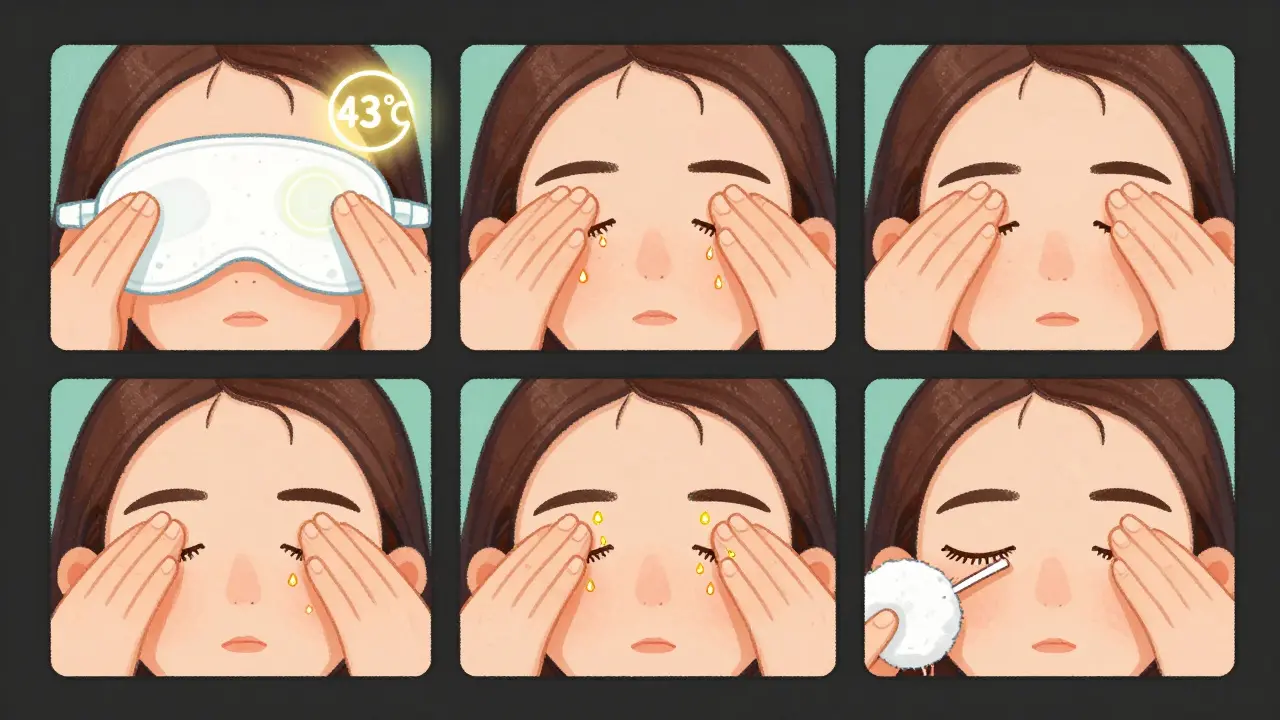
This isn’t just about holding a warm cloth to your eye. It’s a precise routine. Follow these steps exactly:- Heat: Use a microwavable gel pack, a heated eye mask, or a clean washcloth soaked in hot (not boiling) water. Test the temperature on your wrist - it should feel warm but not scalding. Avoid anything over 48°C. That’s when you risk burns.
- Apply: Close your eyes. Place the compress over both eyelids. Set a timer for 10 minutes. Don’t peek. Don’t check your phone. Just relax. If it cools down before 10 minutes, reheat it.
- Massage: Right after the 10 minutes, use your clean fingertip. Gently glide your finger along the upper lid, pushing downward toward your lashes. Then do the same on the lower lid, pushing upward. Do this for 30 seconds. Think of it like squeezing a toothpaste tube - you’re helping the melted oil flow out.
- Cleanse: Use a preservative-free lid scrub or a diluted baby shampoo on a cotton swab. Gently wipe the base of your lashes to remove debris. Don’t scrub hard. Just clean.
- Rinse: Splash cool water on your face to rinse off any residue.
What Works Best: Washcloths vs. Commercial Masks
You don’t need to spend money. A clean washcloth works fine - if you do it right. But if you struggle to keep the heat in, or you keep forgetting, a commercial mask might help. Microwavable gel packs hold heat longer than cloth - about 12.3 minutes on average, compared to 8.7 for washcloths. Brands like Bruder Moist Heat Eye Compress are designed to stay at 43°C for 10-15 minutes. In one study, users of these masks were 27% more likely to stick with treatment past 90 days. Newer devices like the TearCare System deliver precise heat for 15 minutes and are FDA-cleared. But they cost $150-$300. For most people, a $20 reusable mask is enough. The key isn’t the device. It’s consistency.What to Expect - And When to See a Doctor
Don’t expect miracles on day one. Blepharitis is chronic. Improvement takes time. Most people start noticing less crusting and grittiness between 14 and 21 days. By day 30, 85% of those who stick to the routine report significant relief. If you’ve done warm compresses correctly for 4 weeks and still have burning, redness, or blurred vision, see an eye doctor. You might need a short course of antibiotic ointment, anti-inflammatory drops, or even an in-office gland expression. But don’t skip the compresses - they’re still the foundation.
Extra Help: Omega-3s and Lifestyle
Research from the 2023 ARVO conference shows that adding 2,000 mg of EPA/DHA omega-3 fatty acids daily boosts warm compress results by 34%. You can get this from fish oil supplements or eating fatty fish like salmon twice a week. Omega-3s help thin the oil in your glands naturally. Avoid eye makeup while your eyelids are inflamed. It clogs glands. Also, manage skin conditions like rosacea or seborrheic dermatitis - they’re often linked to blepharitis. Use fragrance-free face washes. Wash your pillowcases weekly.Why This Works Better Than Anything Else
Doctors don’t recommend warm compresses because they’re cheap. They recommend them because they work - and they’re the only treatment that targets the root cause: thickened oil in the meibomian glands. Antibiotics treat infection, but most blepharitis isn’t bacterial. Steroids reduce swelling, but they don’t unclog glands. Warm compresses do. One patient on a major eye forum said: “After 3 weeks of doing this right, my eyelids went from glued shut to just a few flakes. I wish I’d done this years ago.” That’s the power of doing it correctly.Final Thought: It’s Not a Quick Fix - But It’s Worth It
Blepharitis doesn’t vanish. But it can become a background noise instead of a daily nuisance. The difference between relief and frustration comes down to two things: temperature and consistency. Get the heat right. Do it every day. Add the massage. Clean gently. And give it time. This isn’t a treatment you do once. It’s a habit you build - like brushing your teeth. And just like brushing, if you skip it, the problem comes back. But if you stick with it? Your eyes will thank you.Can blepharitis cause permanent vision loss?
No, blepharitis itself does not cause permanent vision loss. It’s an inflammation of the eyelid margins, not the eye’s internal structures. However, if left untreated for a long time, it can lead to complications like chronic dry eye, corneal irritation, or eyelash loss - which can temporarily blur vision. These issues usually improve once the inflammation is under control with proper hygiene.
How long should I use warm compresses for blepharitis?
Start with twice daily for 2-4 weeks. Most people see improvement within 14-21 days. After that, switch to once daily for maintenance. Some people need to continue indefinitely, especially if they have underlying conditions like rosacea or oily skin. Think of it like managing dandruff - you don’t stop once it’s gone, you keep doing it to prevent it from returning.
Can I use a heating pad or microwave steam towel instead?
You can, but only if you can control the temperature. A regular heating pad can get too hot and burn your eyelids. Steam towels cool down too fast. Use only products designed for the eyes, or a clean washcloth soaked in hot (not boiling) water. Always test the temperature on your wrist first. The ideal range is 40-45°C. If it feels hot enough to hurt, it’s too hot.
Is blepharitis contagious?
No, blepharitis is not contagious. You can’t catch it from someone else, even through shared towels or makeup. It’s caused by a combination of blocked oil glands, skin bacteria, and sometimes skin conditions like dandruff or rosacea. It’s a personal issue, not an infection you spread.
Should I stop wearing contact lenses if I have blepharitis?
Yes, during active flare-ups. Debris and oil from your eyelids can stick to contact lenses and worsen irritation. Switch to glasses until your symptoms improve. Once your eyelids are stable and you’re following a daily hygiene routine, you can usually return to contacts - but clean them extra well and consider daily disposables to reduce buildup.
Can children get blepharitis?
Yes, children can develop blepharitis, especially if they have eczema, dandruff, or rosacea. It’s often mistaken for “sticky eyes” or conjunctivitis. Treatment is the same - warm compresses and gentle lid cleaning. Use baby shampoo diluted with water for cleaning. If it doesn’t improve in a few weeks, see a pediatric ophthalmologist.



December 30, 2025 AT 13:33 PM
Ugh I tried this for a week and my eyelids felt like sandpaper. Just stopped. Now I just wear sunglasses indoors.
January 1, 2026 AT 07:18 AM
Bro this is actually life-changing. I was using a warm towel for 3 mins and wondering why nothing worked. Started using my Bruder mask for 10 mins + massage and my eyes haven't felt this clear in 5 years. 🙏
January 3, 2026 AT 01:51 AM
Of course it works. You're just too lazy to do it right. Everyone else who actually follows the protocol sees results. Your failure is not the method's fault. Stop blaming the compress.
January 4, 2026 AT 08:56 AM
The meibomian gland dysfunction paradigm is fundamentally sound, but what's rarely addressed is the biofilm matrix formed by Staphylococcus epidermidis on the lash follicles - it's not just viscosity, it's microbial colonization. You need adjunctive antimicrobial peptides or even low-dose doxycycline for true resolution. Warm compresses? Just palliative. The real cure is disrupting the quorum sensing.
January 4, 2026 AT 15:08 PM
Hey, I've been dealing with this since college. I was skeptical too. But doing this every morning - even when I'm tired - made my eyes feel like they used to before the screen life. It's not magic, but it's medicine. And yeah, omega-3s helped me too. Fish oil, not supplements. Real salmon twice a week. Your body knows what it needs.
January 6, 2026 AT 14:48 PM
Look, I've read every study, every meta-analysis, every ophthalmology textbook. Warm compresses are a placebo dressed up as science. The real issue is systemic inflammation from processed carbs and poor gut health. I stopped doing compresses, cut out gluten, started intermittent fasting, and my blepharitis vanished in 11 days. The medical establishment won't tell you this because they make more money selling eye masks than teaching nutrition. You're being manipulated. Again.
January 6, 2026 AT 19:20 PM
So let me get this straight - you're telling me the solution to chronic eye inflammation is... to rub a warm cloth on your face? And this is the gold standard? I'm sorry, but if this is the best medicine can do, we're all doomed. Also, I tried it. My eyelid got burned. Thanks for nothing.
January 7, 2026 AT 19:24 PM
Consistency is non-negotiable. This is not optional. You do it every single day. No exceptions. No excuses. If you miss a day, you reset the clock. Your eyes don't care about your schedule. They care about your discipline. Do it. Or don't. But don't pretend you tried when you didn't.
January 9, 2026 AT 18:35 PM
Everyone’s so obsessed with warm compresses like it’s the holy grail. What about the people who have autoimmune blepharitis? Or those whose glands are permanently destroyed? You’re giving false hope. This isn’t a cure. It’s a Band-Aid on a severed artery. And you’re all pretending it’s enough.
January 11, 2026 AT 04:55 AM
I cried the first time I did this right. After 3 years of feeling like my eyes were full of glitter, I woke up and they just... felt normal. Like, for real normal. I didn't even know I could feel this good. Thank you for this guide. I'm telling all my friends. 💕
January 12, 2026 AT 23:36 PM
The entire premise is a bourgeois fantasy. Warm compresses presuppose leisure, access to microwavable devices, and the cultural capital to prioritize ocular hygiene over labor survival. For the working class, blepharitis isn't a lifestyle problem - it's a structural one. You can't massage your meibomian glands when you're on your third shift and your eyelids are swollen from 12 hours under fluorescent lights. This advice is not medicine - it's moralizing.
And don't get me started on omega-3s. Suggesting salmon as a solution is a luxury tax on poverty. The real fix? Better lighting. Less screen time. Paid sick leave. Universal healthcare. Not a $20 eye mask.
So yes, it works - for people who can afford to care. For the rest of us? We just blink through it.
January 13, 2026 AT 10:54 AM
Warm compresses are not a treatment. They are a hygiene protocol. The distinction matters. You do not treat blepharitis - you manage it. You do not cure it - you contain it. The language you use reflects your understanding. Use precise terminology. Otherwise, you mislead others. And that is irresponsible.