
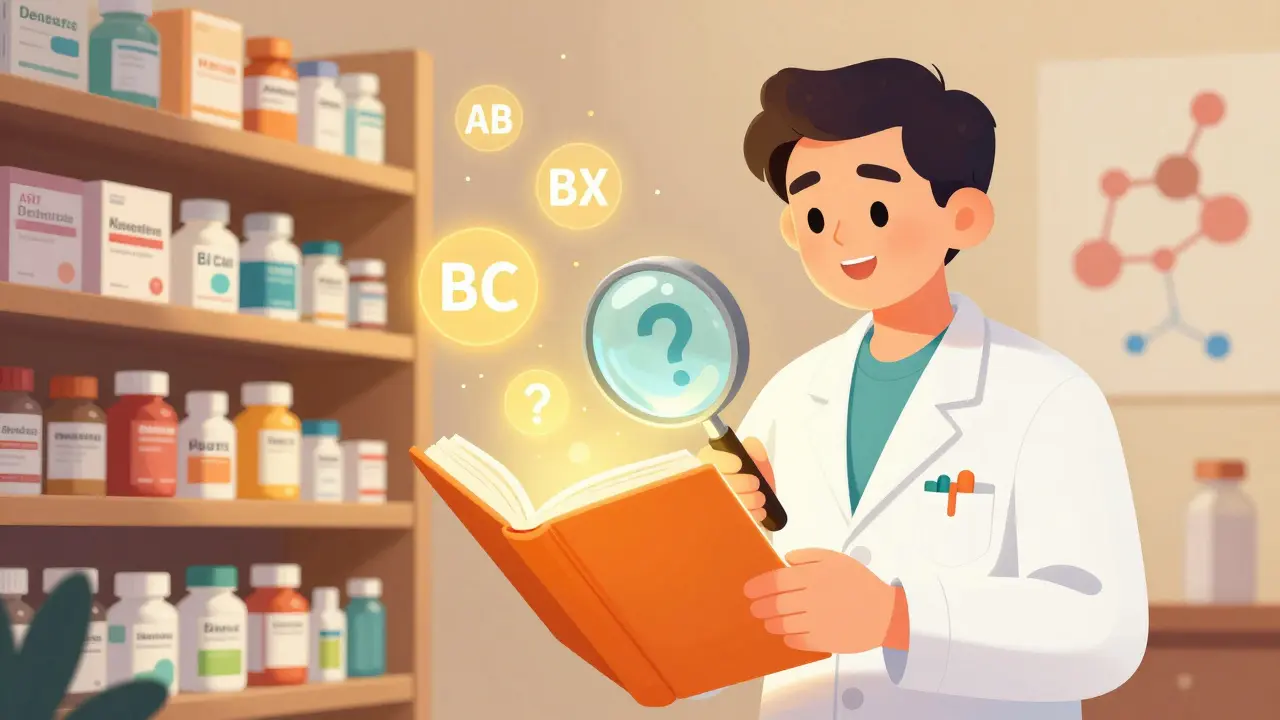
When you pick up a prescription at the pharmacy, you might not realize that the pill in your hand wasn’t the one your doctor wrote on the script. That’s because, in most cases, it’s a generic version - cheaper, just as safe, and approved by the FDA to do the exact same job. But how does the FDA know it’s safe to swap? That’s where therapeutic equivalence codes come in. These simple letter codes - like AB, BC, or BX - are the FDA’s way of telling pharmacists and doctors which generics can be swapped without risk, and which ones need extra caution.
What Are Therapeutic Equivalence Codes?
Therapeutic equivalence codes are part of the FDA’s Approved Drug Products with Therapeutic Equivalence Evaluations, better known as the Orange Book. First published in 1980, this official list is updated every month and tells you which generic drugs are interchangeable with their brand-name counterparts. The system was created after the Hatch-Waxman Act of 1984, which aimed to make generic drugs more accessible without compromising safety. The code itself is made of one or two letters. The first letter is the most important. If it’s an A, the generic is considered therapeutically equivalent to the brand-name drug. That means it has the same active ingredient, same strength, same form (like tablet or capsule), and has passed strict bioequivalence tests. The FDA says this guarantees the generic will work the same way in your body - same effect, same side effects. If the first letter is a B, the FDA hasn’t found enough evidence to say it’s interchangeable. That doesn’t mean it’s unsafe. It just means the data isn’t clear yet. Maybe the drug is an extended-release capsule, a topical cream, or an inhaler - products where it’s harder to prove the body absorbs the medicine the same way. These need more review.What Do the Letters Actually Mean?
Not all A’s are the same. Here’s how the system breaks down:- AB: This is the gold standard. The generic matches the brand in every way and has passed bioequivalence studies. You’ll often see AB1, AB2, AB3 - these just mean there are multiple brand-name versions (called Reference Listed Drugs) for the same drug, and the generic matches one of them specifically.
- BC: Extended-release products where bioequivalence is hard to prove. These are often flagged because the way the drug releases over time might vary slightly between brands.
- BD: Active ingredient has known bioequivalence problems. Rare, but happens with tricky compounds.
- BE: Delayed-release oral products, like enteric-coated tablets. These can be tricky because they’re designed to dissolve in specific parts of the gut.
- BT: Topical products like creams or gels. Absorption through the skin is hard to measure consistently.
- BN: Aerosol or nebulizer products. Delivery method matters a lot here.
- BP: Potential bioequivalence issues. Not confirmed, but under review.
- BR: Suppositories or enemas meant for systemic effect.
- BS: Drug standard issues - like inconsistent manufacturing quality.
- BT: Topical products with bioequivalence concerns.
- BX: Not enough data to decide. These are usually new products or ones with unusual delivery methods.
Only multisource prescription drugs get these codes. That means drugs made by more than one company. Brand-name-only products (like the original Lipitor) don’t get a code - they’re just listed as the Reference Listed Drug.
Why Do These Codes Matter?
In the U.S., 90% of prescriptions are filled with generics. But generics make up only 23% of total drug spending - saving patients and insurers about $370 billion a year. That’s possible because of the Orange Book and these codes. Pharmacists rely on them daily. In 49 states, pharmacists can swap a brand-name drug for an A-rated generic without asking the doctor. That saves time, money, and hassle. A 2022 survey found 87% of community pharmacists use the Orange Book at least once a week to check codes before dispensing. But here’s the catch: not everyone understands the system. A 2022 American Medical Association survey showed 42% of doctors are confused by B codes. Some think a B-rated drug is unsafe - when it might just be complex. Others mistakenly think an A-rated drug is always better than a B-rated one. That’s not true. A B-rated drug might be perfectly fine - it just hasn’t been studied enough to get an A.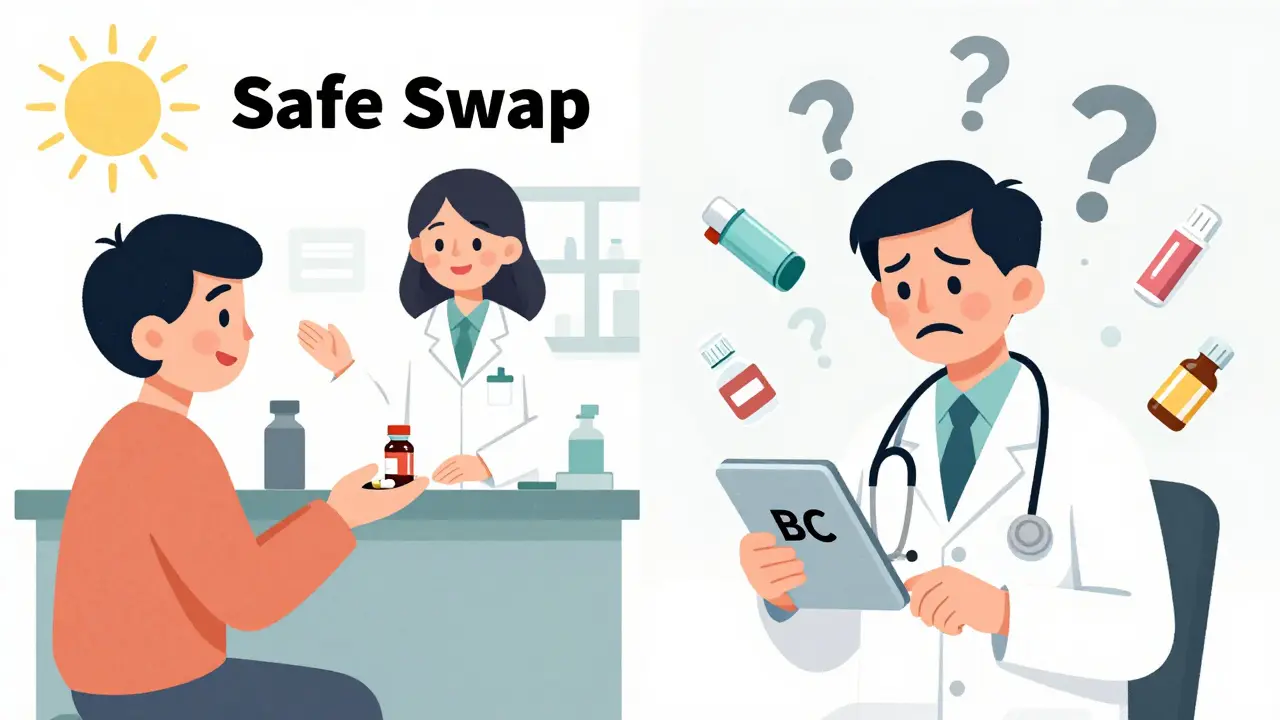
What’s the Problem With B-Rated Drugs?
The biggest issue isn’t safety - it’s uncertainty. Complex drugs like inhalers, injectables, or topical creams don’t always behave the same way in the body even if they look identical on paper. Traditional bioequivalence tests - which measure blood levels of the drug - don’t always capture how the medicine works in the tissue. For example, two asthma inhalers might release the same amount of medicine into the bloodstream, but one might deliver it deeper into the lungs. That difference could matter for the patient. Right now, the FDA doesn’t have a standardized way to test that. So those products often get a B code - even if they work fine in real life. Dr. Duxin Sun from the University of Michigan points out that the current system was built for simple pills. It’s struggling to keep up with modern drug delivery systems. Between 2018 and 2022, the number of B-rated applications for complex generics rose by 22%.How Do Pharmacists Use These Codes?
Pharmacists don’t just guess. They check the Orange Book - online or in print - before substituting. They look for two things: pharmaceutical equivalence (same ingredient, strength, form) and the therapeutic equivalence code. If it’s an A-rated drug, they can swap it. In most states, they don’t even need to tell the doctor. But if it’s a B-rated drug, rules change. In 38 states, pharmacists must notify the prescriber before substituting. Some states require the doctor to specifically write “dispense as written” on the prescription to block substitution. It’s not just about legality - it’s about safety. A 2023 study found pharmacists spend an average of 2.7 minutes per prescription verifying TE codes. That adds up to $1.2 billion in savings each year from avoiding unnecessary brand-name use.How Does This Compare to Other Countries?
The U.S. system is unique. In Europe, the European Medicines Agency doesn’t use letter codes. Instead, they publish detailed scientific reviews for each generic application. That’s more thorough - but less practical for pharmacists on the front lines. The FDA’s system is built for speed and clarity. It gives a clear yes-or-no answer: swap or don’t swap. That’s why it’s worked so well for over 40 years. But as drugs get more complex, that simplicity is starting to show cracks.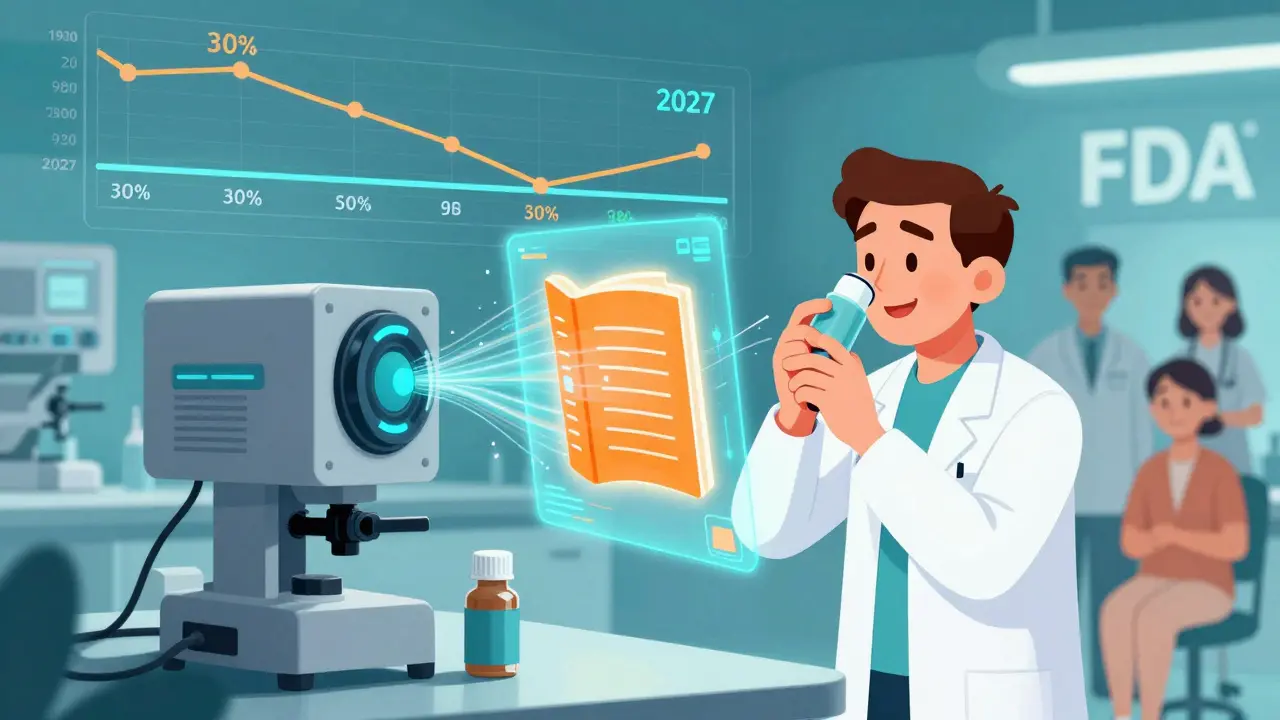
What’s Changing in 2025?
The FDA is working on updates. In 2022, they released a draft guidance to improve how they evaluate complex generics. They’re expanding their Product-Specific Guidelines - now over 1,850 documents - to give manufacturers clearer rules on how to prove bioequivalence for tricky drugs. The goal? Reduce B-rated products for complex generics by 30% by 2027. That means better science, better tests, and more generics that can be swapped without hesitation. They’re also exploring real-world data - like patient outcomes from electronic health records - to supplement lab-based bioequivalence studies. That could help classify products that work well in practice, even if lab tests are inconclusive.What Should You Do?
If you’re a patient: Don’t panic if your generic has a B code. Ask your pharmacist: “Is this safe to swap?” They can tell you if it’s just a data issue or something more serious. If you’re a prescriber: Know your codes. Don’t assume a B-rated drug is inferior. Sometimes it’s just the FDA hasn’t caught up yet. If you’re unsure, check the Orange Book or ask your pharmacy. If you’re a pharmacist: Use the Orange Book every time. Don’t rely on memory. And if a patient questions a substitution, explain what the code means - it builds trust.Final Thoughts
Therapeutic equivalence codes are one of the quiet heroes of modern medicine. They make generics safe, affordable, and widely available. But they’re not perfect. As drugs get more complex, the system has to evolve. Right now, it works for pills - and that’s most of what we take. But for inhalers, creams, and injectables? We’re still learning. The FDA isn’t abandoning the system. They’re upgrading it. And for now, if you see an A code, you can be confident - your generic is just as good as the brand.What does an AB code mean on a generic drug?
An AB code means the generic drug is therapeutically equivalent to the brand-name drug. It has the same active ingredient, strength, dosage form, and route of administration, and has passed FDA bioequivalence testing. This means it will work the same way in your body and can be safely substituted without a doctor’s approval in most states.
Can I substitute a B-rated generic for a brand-name drug?
It depends. A B-rated drug hasn’t been proven equivalent by the FDA’s current standards. In most cases, pharmacists can’t substitute it without the prescriber’s permission. Some B-rated drugs may be clinically equivalent, but the data isn’t strong enough for an A rating - especially for complex products like inhalers or topical creams. Always check with your pharmacist or doctor before switching.
Why do some generic drugs have different AB codes like AB1, AB2, or AB3?
When multiple brand-name drugs (called Reference Listed Drugs) exist for the same active ingredient, each gets its own AB code. AB1 means the generic matches the first brand listed, AB2 matches the second, and so on. This matters because even though two brands have the same active ingredient, their formulations might differ slightly - affecting how the generic is approved. Pharmacists must match the generic to the correct reference drug to ensure safe substitution.
Are over-the-counter (OTC) drugs assigned therapeutic equivalence codes?
No. The FDA’s therapeutic equivalence system only applies to prescription drugs. OTC medications aren’t evaluated or coded in the Orange Book. Substitution of OTC drugs is handled by pharmacy policy or state regulations, but not through the FDA’s TE code system.
Where can I look up therapeutic equivalence codes?
The official source is the FDA’s Orange Book website, which is updated monthly. You can search by brand name, generic name, or active ingredient. Many pharmacy software systems also pull this data automatically. Pharmacists use it daily to verify substitution eligibility. The site had over 1.7 million unique visitors in Q2 2023 - proof of how widely it’s used.

December 29, 2025 AT 07:07 AM
Oh great, so now we have a whole alphabet soup just to tell us if our cheap pills will kill us or not. AB? BC? BX? Sounds like the FDA ran out of ideas and started playing Scrabble with pharmacology. I got a B-rated inhaler last month and my lungs still work. Coincidence? Maybe. Or maybe the system’s broken.
December 29, 2025 AT 08:46 AM
You people are overcomplicating this. If it’s not AB, don’t use it. Period. The FDA doesn’t play games. If they say B, it’s because the generic is garbage. Stop trying to rationalize it. Just get the brand. Your life isn’t worth saving $15.
December 31, 2025 AT 03:39 AM
I actually love learning about this stuff! My grandma’s on a B-rated blood thinner and I was terrified at first, but her pharmacist sat down with us and explained it’s not unsafe-just harder to test. Turns out, she’s been on it for years and her numbers are perfect. So maybe ‘B’ doesn’t mean ‘bad’? Just ‘needs more research’?
January 1, 2026 AT 10:12 AM
The Orange Book is a joke. I’ve seen generics with the same AB code that behave completely differently. One batch made me dizzy, the next didn’t. The FDA doesn’t test batches. They test prototypes. That’s not safety. That’s gambling with your health.
January 1, 2026 AT 13:47 PM
This is a well-structured overview. The distinction between pharmaceutical equivalence and therapeutic equivalence is often misunderstood. Bioequivalence studies are statistically rigorous, but the limitations for complex formulations are real. The FDA’s approach, while imperfect, balances access and safety better than most systems. The rise in B-rated complex generics reflects scientific progress, not system failure.
January 2, 2026 AT 01:12 AM
Let me tell you about the time my doctor switched me to a B-rated topical cream for my eczema. I was like, ‘NOPE, I’m not some lab rat.’ But guess what? It worked better than the brand. Like, way better. My skin actually calmed down. Turns out the FDA doesn’t know everything. Sometimes the ‘B’ is just a bureaucratic glitch. Pharmacies should be allowed to use real-world evidence, not just lab numbers.
January 2, 2026 AT 23:01 PM
AB = bioequivalent. B = not. End of story. Stop over-analyzing. If you’re using a BX-rated drug, you’re already on the edge of clinical negligence. The Orange Book exists because people like you need a binary answer. Stop asking for nuance. It’s not a philosophy paper.
January 4, 2026 AT 17:14 PM
i read this whole thing and honestly? the us system is kinda wild. in the uk we just get the generic and if it dont work we switch. no codes, no orange book, just… trust the doc and the pharmacist. maybe we’re too chill? or maybe you guys are over-engineering this?
January 6, 2026 AT 10:54 AM
B-rated drugs are a scam. 🤡 Big Pharma lets generics in just enough to look like they’re lowering prices, but keeps the complex ones locked down so they can charge $800 for a puff. And now they’re calling it ‘scientific uncertainty’? Please. It’s profit. 🧪💸
January 7, 2026 AT 20:23 PM
I get why people are nervous about B codes, but I think we need to stop treating them like red flags. My mom’s on a B-rated insulin pen-she’s been stable for 3 years. The system isn’t perfect, but it’s trying. Maybe instead of fear, we need more education? Like, real conversations, not just panic Google searches.
January 7, 2026 AT 22:12 PM
It’s funny how we treat drugs like they’re all the same. A pill is a pill, right? But then you realize-some pills are engineered like Swiss watches, and others are just… pressed powder. The AB code is the FDA’s way of saying, ‘This one’s a watch.’ The B? ‘This one’s a hammer.’ Both work. One’s just more predictable.
January 8, 2026 AT 08:14 AM
I work in a pharmacy and let me tell you-we check the Orange Book every single time. No exceptions. I had a patient cry because she thought her B-rated drug meant she was getting ‘second-rate’ medicine. I showed her the studies, explained the science, and she left with a hug and a thank you. This system isn’t perfect, but when we take the time to explain it? It saves lives.
January 9, 2026 AT 15:37 PM
The FDA’s system is a relic. A 1984 framework trying to manage 2025 nanotech inhalers? Pathetic. The Orange Book reads like a college textbook written by someone who hasn’t touched a lab since 1999. If you’re still using letter codes to classify complex biologics, you’re not innovating-you’re just bureaucratizing.