
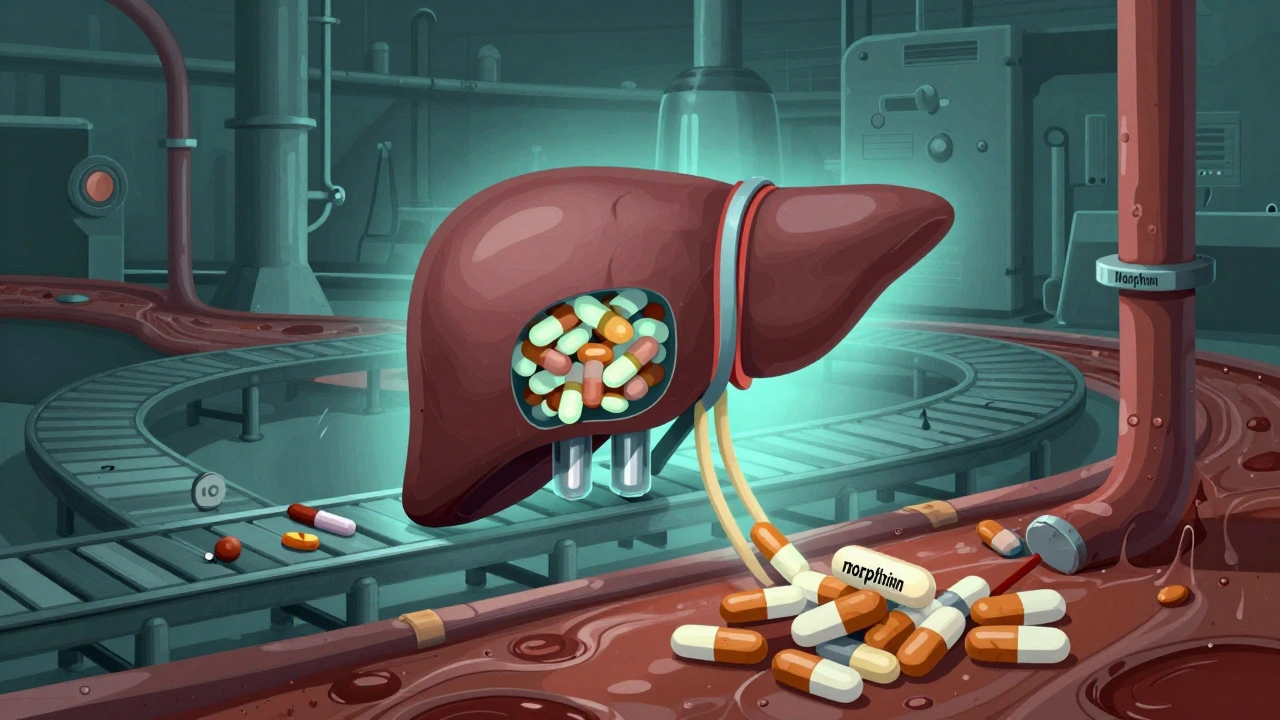
Liver disease reduces drug clearance by 30-50%, leading to dangerous drug buildup. Learn how enzyme changes, blood flow, and liver scoring affect medication safety-and what dosing adjustments actually work.
Drug Metabolism: How Your Body Processes Medications and Why It Matters
When you take a pill, your body doesn’t just store it—it drug metabolism, the biochemical process that breaks down medications so they can be eliminated or activated. Also known as pharmacokinetics, it’s what decides whether a drug works, lasts too long, or turns toxic. This isn’t just science—it’s the reason your doctor checks blood levels for antidepressants, warns you about mixing painkillers with alcohol, or switches you from one opioid to another.
Drug metabolism happens mostly in the liver, using enzymes like CYP3A4 and CYP2D6. But not everyone has the same enzymes. Some people break down drugs fast—meaning the medicine doesn’t work. Others process them slowly, risking overdose even at normal doses. That’s why therapeutic drug monitoring, measuring drug levels in the blood to ensure safe and effective dosing is critical for drugs like tricyclic antidepressants or carbamazepine. Without it, you might think you’re taking the right amount, but your body is handling it completely differently than expected.
And it’s not just about the drug itself. What else you take changes everything. drug interactions, when one substance alters how another is metabolized can turn a safe dose into a dangerous one. Acid-reducing pills like omeprazole can block absorption of antifungals. Ginkgo biloba can thin your blood when mixed with warfarin. Even grapefruit juice can stop your liver from breaking down statins—leading to muscle damage. These aren’t rare edge cases. They happen daily, and most people don’t know they’re at risk.
That’s why medication absorption, how and where a drug enters your bloodstream matters just as much as metabolism. A drug might be perfectly broken down by your liver, but if it never gets absorbed because of an empty stomach or a gut condition, it’s useless. That’s why some meds need to be taken with food, others on an empty stomach, and why counterfeit pills often fail—they don’t dissolve right.
Understanding drug metabolism helps explain why opioid rotation works, why long-acting injectables need extra monitoring, and why generic drugs aren’t always interchangeable in practice. It’s the hidden layer behind every side effect, every warning label, every dose adjustment. You don’t need to be a pharmacist to get it—you just need to know that your body’s chemistry is unique, and drugs don’t behave the same in everyone.
Below, you’ll find real-world guides on how this plays out in practice: from how to avoid deadly toxicity with antidepressants, to why switching opioids reduces side effects, to how to spot fake meds that bypass your body’s natural processing entirely. These aren’t theory pieces—they’re tools to help you stay safe, ask better questions, and take control of what’s actually happening inside you.