
Specialty pharmacy isn’t just another pharmacy
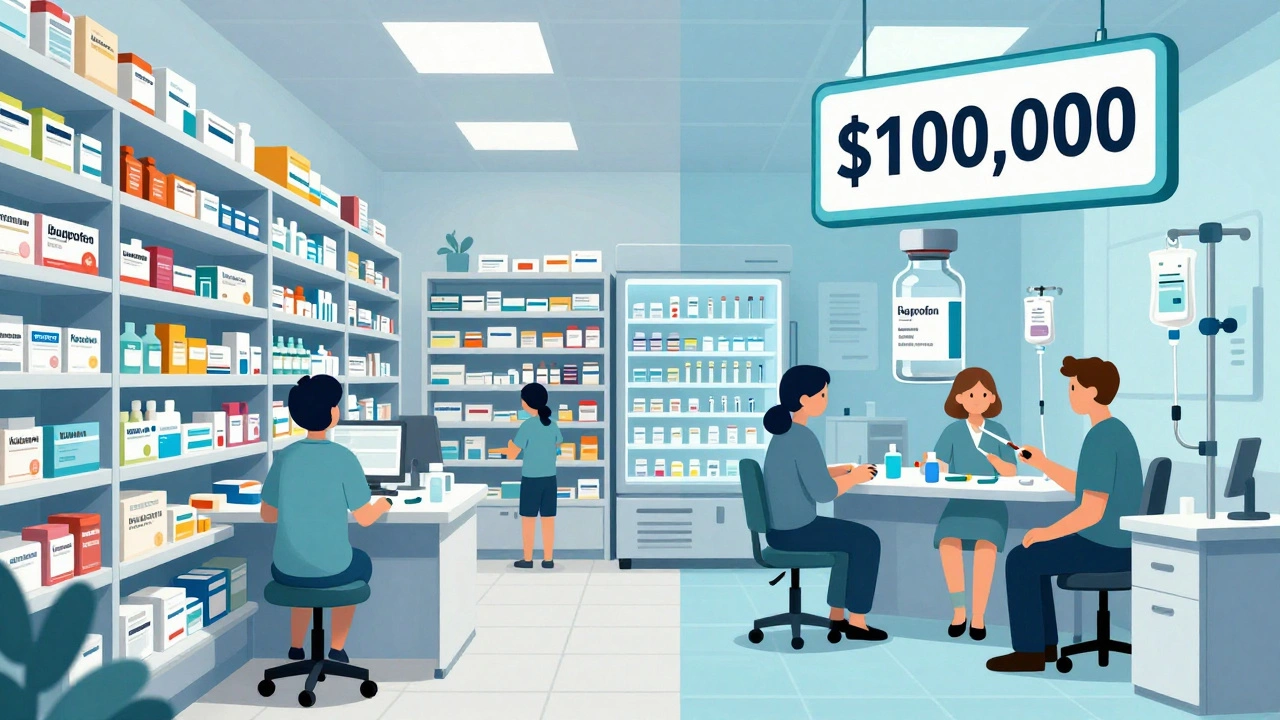
When you walk into a community pharmacy, you’re used to seeing shelves full of pills-ibuprofen, metformin, lisinopril-all cheap, easy to stock, and often generic. But specialty pharmacies? They’re a different world. These aren’t your run-of-the-mill drug outlets. They handle medications that cost thousands per month, need refrigeration, require injections or infusions, and are used for life-altering conditions like cancer, multiple sclerosis, or rheumatoid arthritis. And here’s the twist: while generics have transformed how we think about everyday prescriptions, they’ve made specialty pharmacy way more complicated-not simpler.
Why specialty drugs are so expensive-and why generics matter
Specialty medications aren’t just pricey because they’re complex. They’re expensive because they’re biologics: large, intricate molecules made from living cells. Think of them like a hand-sculpted statue versus a mass-produced plastic toy. The cost? Often over $1,000 a month. A single course of treatment for some autoimmune diseases can hit $100,000 a year. That’s why when a generic version finally arrives, it’s a game-changer.
Take Copaxone, a drug for multiple sclerosis. Before its generic version came out, patients paid around $78,000 annually. After the generic glatiramer acetate hit the market, the price dropped to $45,000. That’s still steep, but it’s a 42% cut. And that’s not rare. Generic drugs, on average, cost 80-85% less than their brand-name equivalents. For specialty pharmacies, that’s not just a savings-it’s a lifeline for patients who can’t afford treatment.
Generics aren’t always interchangeable-especially in specialty care
Here’s where things get tricky. The FDA says generics are bioequivalent to brand drugs. That means they deliver the same active ingredient at the same rate and amount. Sounds perfect, right? But in specialty pharmacy, bioequivalence doesn’t always mean clinical equivalence.
For drugs with a narrow therapeutic index (NTI)-like levothyroxine, warfarin, or some epilepsy meds-tiny differences in blood levels can mean the difference between control and crisis. Patients who’ve been stable on a brand drug for years can start having seizures, thyroid spikes, or dangerous clots after switching to a different generic manufacturer. Why? Because inactive ingredients (excipients) change. The pill might look different. The coating might dissolve faster. The filler might trigger an allergy.
One 2022 survey of specialty pharmacy staff found that 78% of them said managing patient concerns about generic substitutions was a major workflow headache. Patients show up confused: “This pill is blue now, not white. Did they give me the wrong drug?” Pharmacists have to explain that color doesn’t matter-but it’s still a battle.

Biosimilars: the next frontier
Generics for small-molecule drugs are one thing. But what about biologics? That’s where biosimilars come in. These aren’t exact copies-because you can’t copy a living cell like you copy a chemical formula. They’re highly similar versions, approved under the Biologics Price Competition and Innovation Act (BPCIA) of 2009. As of December 2023, the FDA had approved 35 biosimilars.
Humira, the top-selling drug in the U.S. for years, finally got its first biosimilars in 2023 after years of patent battles. Now, instead of paying $20,000 a year for Humira, patients might pay $8,000 for an adalimumab biosimilar. That’s huge. But here’s the catch: biosimilars aren’t automatically interchangeable. Only one, Semglee (a biosimilar to insulin glargine), has been approved as “interchangeable” by the FDA-meaning a pharmacist can swap it without the prescriber’s OK, just like a regular generic.
For specialty pharmacies, this means new rules. You can’t just swap a biosimilar like you swap a generic. You need documentation. You need consent. You need to track which version the patient is on. And you need to educate them-because many still think “biosimilar” means “inferior.”
Pharmacy benefit managers are making it harder
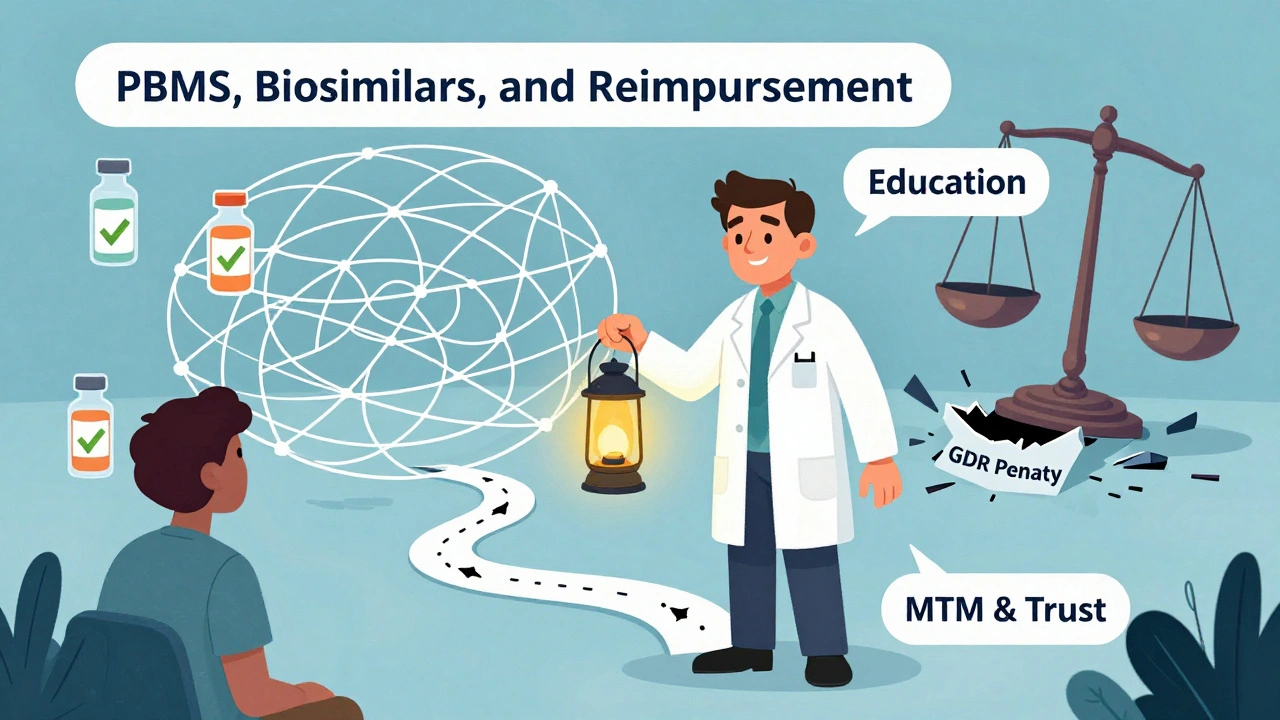
It’s not just the science that’s complicated. It’s the money. Pharmacy Benefit Managers (PBMs) control which drugs get covered, how much they pay pharmacies, and what incentives they offer. Many PBMs set a Generic Dispensing Ratio (GDR)-a target for how many prescriptions should be filled with generics. Sounds fair? Not in specialty pharmacy.
Here’s the problem: if a specialty pharmacy doesn’t have a generic version of a drug, they still get penalized for not hitting the GDR. One pharmacy owner told me they were fined $12,000 last year because they didn’t dispense enough generics-despite the fact that 90% of their drugs had no generic alternative. PBMs don’t care. They measure the ratio, not the reality.
And reimbursement? It’s broken. Specialty pharmacies often buy drugs at $1,200 and get reimbursed $1,100 by the PBM. That’s a $100 loss per script. Meanwhile, community pharmacies make money on generics because they buy them cheap and sell them at a markup. Specialty pharmacies are stuck paying high prices and getting paid less. Some are going out of business.
What specialty pharmacies must do differently
If you run or work in a specialty pharmacy, here’s what you need to do differently than in a retail setting:
- Standardize your generics. Don’t stock five different brands of the same generic drug. Pick one that’s proven reliable, has consistent supply, and matches your patients’ needs. Complexity kills efficiency.
- Track excipients. If a patient has a known allergy to lactose, corn starch, or a dye, you need to know which generic version contains it. Build that into your system.
- Document substitution decisions. Never switch a patient on a narrow therapeutic index drug without a clear reason, documentation, and follow-up. Record the brand and generic name, date, and reason for change.
- Monitor after switch. For NTI drugs, check blood levels within 4-6 weeks after switching. Don’t assume it’s fine because the FDA says so.
- Educate patients. Use simple language: “This pill works the same way, but it’s made by a different company. It might look different, but it’s safe.”
- Work with one distributor. McKesson and others recommend sourcing generics from a single, reliable distributor. Jumping between suppliers adds administrative chaos and increases the risk of stockouts or errors.
The patient experience: confusion, fear, and hope
Patients don’t care about PBM policies or bioequivalence studies. They care if their pain is controlled, if they can breathe, if they can get out of bed. When their medication changes unexpectedly, they panic. Reddit threads are full of stories: “My tremors came back after switching generics.” “I got sick every time they changed the pill.”
But there’s hope. One 2014 study showed that with proper specialty pharmacy support-medication therapy management, home delivery, nurse calls-adherence to MS drugs jumped from 33% to 60%. That’s not just about the drug. It’s about the care around it.
When patients understand why a biosimilar is safe, when they’re involved in the decision, when their pharmacist takes time to explain, they’re more likely to stick with it. And that’s the real value of specialty pharmacy: not just dispensing drugs, but managing people.
The future: more biosimilars, more pressure, more responsibility
More blockbuster biologics are losing patents every year. Humira’s biosimilars are just the start. Enbrel, Remicade, and others will follow. By 2030, biosimilars could save the U.S. healthcare system over $50 billion.
But that only happens if specialty pharmacies are supported-not punished. PBMs need to stop penalizing pharmacies for not having generics that don’t exist. Regulators need to make interchangeable biosimilars easier to adopt. Pharmacists need better tools to track substitutions and communicate with patients.
The bottom line? Specialty pharmacy is no longer optional. It’s essential. And as generics and biosimilars grow, the role of the pharmacist is shifting from order filler to care coordinator. That’s not a burden. It’s the future.
Can a generic drug be substituted for a specialty medication without the prescriber’s approval?
It depends. For traditional small-molecule generics, yes-if state law allows and the drug isn’t on a narrow therapeutic index list. But for biosimilars, it’s different. Only one biosimilar, Semglee, is currently FDA-approved as interchangeable, meaning a pharmacist can substitute it without a new prescription. For all others, even if they’re biosimilars, the prescriber must approve the switch. Always check state regulations and drug-specific rules before substituting.
Why do some patients have side effects after switching to a generic?
The active ingredient is the same, but the inactive ingredients-like fillers, dyes, or coatings-can differ between manufacturers. For most people, this doesn’t matter. But for patients with allergies, sensitivities, or those on narrow therapeutic index drugs (like levothyroxine or warfarin), even small changes can affect absorption or trigger reactions. That’s why switching these patients without monitoring can be risky.
Are biosimilars as safe as brand-name biologics?
Yes. Biosimilars undergo the same rigorous testing as brand-name biologics, but they’re not exact copies. They’re highly similar, with no clinically meaningful differences in safety or effectiveness. The FDA requires extensive studies comparing biosimilars to the original product. Over 35 have been approved, and real-world data from Europe and the U.S. shows they perform just as well. The biggest barrier isn’t safety-it’s cost, confusion, and payer policies.
Why do specialty pharmacies get penalized for low generic dispensing rates?
Pharmacy Benefit Managers (PBMs) often set Generic Dispensing Ratio (GDR) targets to reduce costs. But many specialty drugs-especially biologics-have no generic or biosimilar available. Penalizing pharmacies for not dispensing generics that don’t exist is flawed. It creates financial pressure without reflecting real-world practice. Some pharmacies have been fined thousands for this reason, even when they’re doing everything right.
How can specialty pharmacies improve patient adherence with generics?
Adherence improves when patients understand why the switch happened and feel involved. Use clear communication: show them the new pill, explain why it’s safe, and offer follow-up calls. Medication therapy management (MTM) programs-where pharmacists check in regularly, monitor labs, and answer questions-can boost adherence by up to 30%. Also, avoid switching patients unless necessary. Stability matters more than cost in specialty care.



December 4, 2025 AT 05:45 AM
I've seen this play out with my mom on her MS med. Switched to generic and she got dizzy for weeks. Turned out the filler was different. Took three calls to the pharmacy to get her back on the original brand. No one warned us.
Specialty pharma needs to treat patients like humans, not numbers.
December 5, 2025 AT 03:02 AM
YES. This. 🙌 I work in a specialty pharmacy and we just got hit with a PBM penalty for not hitting 70% generic rate when 80% of our meds have NO generic. We're losing money on every script and getting yelled at for not being 'cost-efficient'. It's insane. We're not retail. We're life support.
December 7, 2025 AT 02:48 AM
The FDA says bioequivalent but patients don't care about that
December 8, 2025 AT 22:37 PM
You think this is bad wait till the PBM starts forcing biosimilar swaps without telling the prescriber. They're already doing it in some states. Next thing you know grandma's on a new drug she's never heard of and her kidney values are all over the place. This isn't science. It's accounting.
December 9, 2025 AT 14:32 PM
I've worked in specialty pharmacy across three states and the biggest issue isn't the drugs-it's the lack of communication. Pharmacists are the only ones who know the patient's full story. Yet we're treated like order fillers. When a patient switches from Humira to a biosimilar, they need a 15-minute consult. Not a 30-second script handoff. We're not just dispensing-we're managing chronic illness. That deserves respect.
December 10, 2025 AT 16:33 PM
In Nigeria we dont have this problem because most specialty drugs are not available at all. But when they are, we dont have generics because the supply chain is too broken. So patients either pay full price or dont get treated. Your system is broken in a different way but the pain is the same.
December 12, 2025 AT 06:07 AM
Bioequivalence is a regulatory fiction. Real-world pharmacokinetics vary by 20% between generic manufacturers. The FDA approval process is a joke. You think a pill made in India with corn starch filler is the same as one made in Germany with lactose monohydrate? Wake up. This isn't medicine. It's commodity trading dressed in white coats.
December 12, 2025 AT 13:18 PM
I can't believe anyone still trusts generics for NTI drugs. You're literally gambling with someone's life. And don't even get me started on PBMs-these are the same people who got us the opioid crisis. They don't care about patients. They care about quarterly reports. This whole system is a Ponzi scheme built on suffering.
December 14, 2025 AT 06:07 AM
The fact that you're even discussing this as if it's a legitimate medical issue shows how naive you are. It's not about safety. It's about profit. Biosimilars are cheaper because they're cut corners. The FDA lets them slide because Big Pharma paid off the regulators. You think Semglee is really 'interchangeable'? It's just the first step before they phase out the original entirely. Watch.
December 15, 2025 AT 10:53 AM
I've been a specialty pharmacist for 18 years. The key is consistency. Pick one generic manufacturer. Stick with it. Train your team to track excipients. Talk to patients like they're people. Don't just hand them a pill and say 'it's the same.' That's how trust dies. We're not just pharmacists-we're the last line of defense for people who have nowhere else to turn. Don't forget that.