
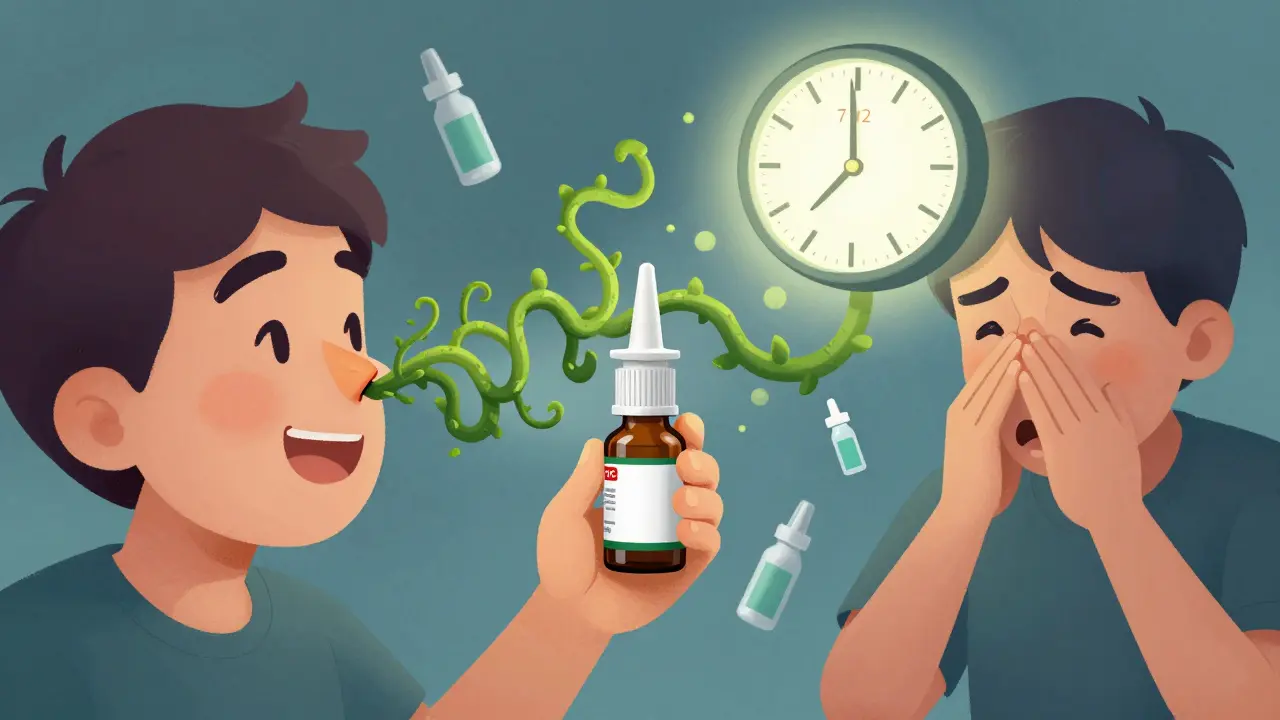
Most people reach for an OTC nasal spray when their nose is stuffed up - whether from a cold, allergies, or sinus pressure. It works fast. Within minutes, you can breathe again. That instant relief is why these sprays are among the most popular over-the-counter remedies. But here’s the catch: if you use them for more than three days, they can make your congestion worse. This isn’t a myth. It’s a real, well-documented condition called rhinitis medicamentosa - or rebound congestion.
How OTC Nasal Sprays Work (and Why They Backfire)
OTC nasal decongestant sprays like Afrin, Neo-Synephrine, and Otrivin contain active ingredients such as oxymetazoline or phenylephrine. These are alpha-adrenergic agonists. In plain terms, they shrink the swollen blood vessels in your nasal lining. That’s why you feel immediate relief. The effect kicks in within 5 to 10 minutes and lasts 8 to 12 hours.
But here’s what happens after the medication wears off: your blood vessels don’t just return to normal. They overcompensate. They dilate even more than before, causing worse congestion. Your body starts to rely on the spray to keep things open. So you use it again. And again. Soon, you’re spraying six, eight, even ten times a day. That’s the cycle. And once it starts, it’s hard to break.
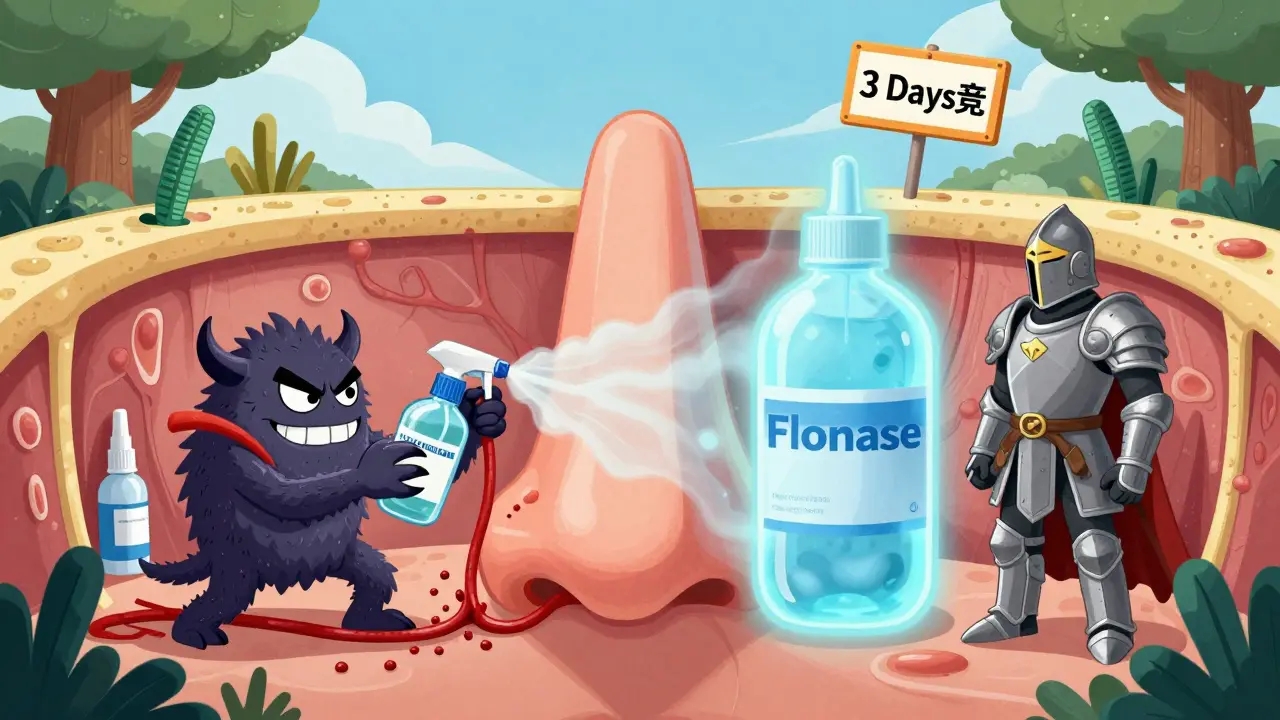
Medical studies show this rebound effect can begin as early as 72 hours - just three days - of continuous use. The NIH’s StatPearls database and Cleveland Clinic both confirm that using these sprays beyond three to five days significantly increases your risk. It’s not about how much you use each time. It’s about how many days in a row you use them.
Who Gets Rebound Congestion - And Why It’s More Common Than You Think
You might assume only heavy users get rebound congestion. But that’s not true. About 1 to 2% of the general population develops this condition, according to Cleveland Clinic data. In ENT clinics, it’s a common enough issue that specialists see thousands of cases each year. The real problem? Most people don’t realize what’s happening.
Patients often think their allergies are getting worse, or that their cold is turning into a sinus infection. They don’t connect the dots between the spray and the worsening symptoms. Reddit communities like r/Allergies are full of posts from people describing "Afrin hell" - weeks of misery after they couldn’t stop using the spray. One user wrote: "I thought my allergies were getting worse, but it was the spray making it worse."
Rebound congestion doesn’t come with sneezing, itching, or watery eyes - the usual signs of allergies. It’s just pure, stubborn nasal blockage. No runny nose. No sneezing. Just congestion that gets worse the more you spray.
The Dangers of Long-Term Use
Using nasal decongestant sprays for weeks or months doesn’t just cause rebound. It can damage your nasal tissue. Chronic overuse can lead to:
- Thinning of the nasal mucosa
- Increased risk of nosebleeds
- Chronic sinusitis
- In rare cases, perforation of the nasal septum
WebMD and the Mayo Clinic both warn that long-term misuse can permanently alter the structure of your nasal passages. And it’s not just physical damage. The dependency cycle creates real psychological stress. People feel trapped. They can’t sleep. They can’t work. They’re stuck in a loop they don’t know how to escape.
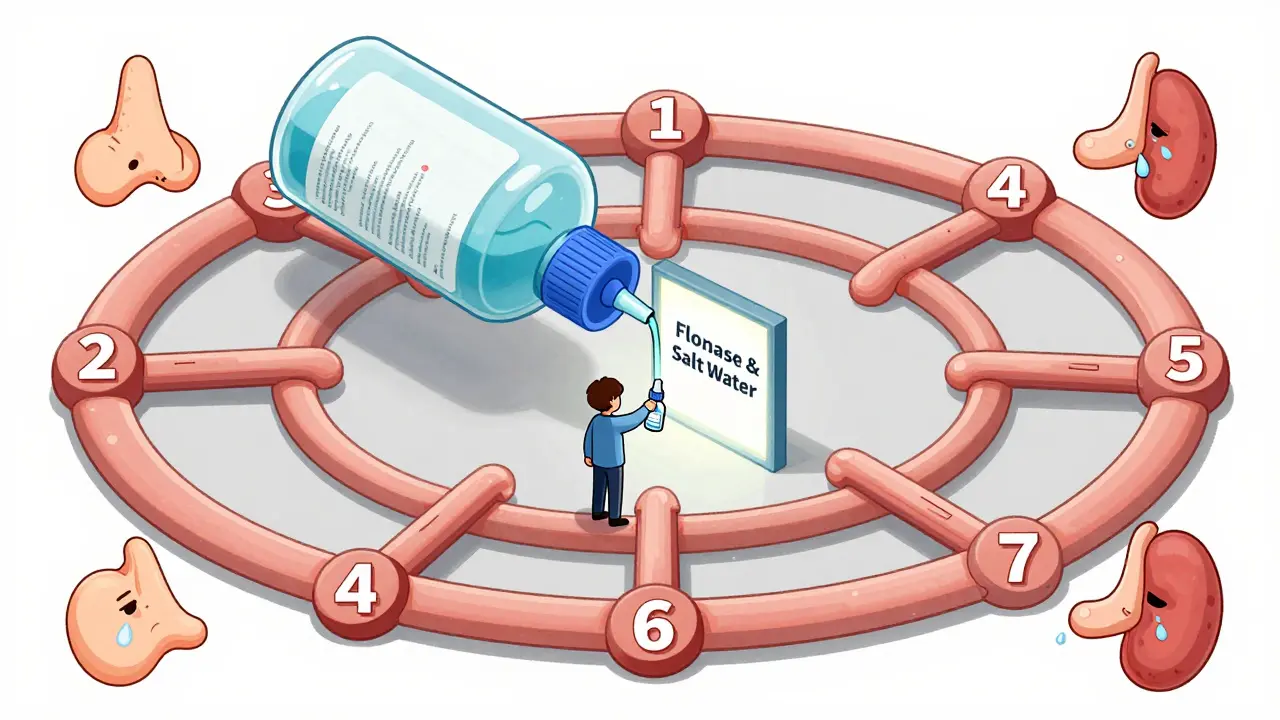
What to Use Instead - And How to Break the Cycle
There are safer, long-term options. The key is switching to treatments that don’t cause rebound.
- Saline nasal sprays - These are just salt water. No medication. No side effects. You can use them as often as you need. They help clear mucus, reduce irritation, and keep nasal passages moist. Brands like NeilMed Sinugator cost around $15 and are effective for daily use.
- OTC steroid sprays - Flonase Sensimist (fluticasone) and Nasacort (triamcinolone) became available over-the-counter in 2014. They take 3 to 7 days to work, but once they do, they reduce inflammation without any rebound risk. They’re perfect for allergies or chronic congestion. A 120-spray bottle costs about $25.
- Oral decongestants - Pseudoephedrine (Sudafed) can help, but it’s not for everyone. It can raise blood pressure by 5-7 mmHg and may cause jitteriness or insomnia. If you have high blood pressure, heart issues, or glaucoma, avoid it.
If you’ve already developed rebound congestion, here’s how to get out of it:
- Stop using the decongestant spray completely. No exceptions.
- Start using a steroid nasal spray (like Flonase) daily - even if you don’t feel better right away. It takes 3-5 days to kick in.
- Use saline spray 4-6 times a day to soothe and flush out your nose.
- Be patient. Symptoms may get worse for the first 2-3 days after stopping. That’s normal. Peak discomfort usually hits at 48-72 hours.
- Recovery typically takes 7-21 days with this approach. Without proper management, it can take up to six weeks.
Some doctors recommend starting the steroid spray 1-2 days before quitting the decongestant. This gives your body a head start on reducing inflammation before the rebound hits.
Why You’re Still Using It - And How to Stop
Why do people keep using these sprays even after they know the risks? Because the relief is so immediate. When you’re struggling to breathe, it’s hard to think about long-term consequences. The temptation to spray again is strong.
Here’s a trick that works: keep a spray diary. Write down each time you use it. Set a phone alarm for every 24 hours. When the alarm goes off, ask yourself: "Am I using this because I need it - or because I’m scared of the congestion?"
Also, don’t keep extra bottles around. Once you’ve used one, throw it away. Don’t buy another until you’re sure you won’t need it. Out of sight, out of mind.
What the Experts Say
Dr. Rami Ahmed, an otolaryngologist at Houston Methodist, says: "Patients often don’t realize their congestion is caused by the medication itself. They think it’s getting worse - not that it’s a side effect of the treatment."
The FDA has required the "Do not use for more than 3 days" warning on all OTC nasal sprays since 2002. But surveys show 38% of users still exceed that limit. That’s not ignorance. It’s habit.
Experts now recommend a proactive approach: if you think you’ll need a decongestant spray for more than two days, start a steroid spray on day one. This prevents the rebound before it starts.
Market Reality: Why These Sprays Are Everywhere
The U.S. OTC nasal spray market was worth $1.2 billion in 2022. Afrin alone holds 32% of the market. Store brands make up 44%. But here’s the truth: they all contain the same active ingredients. The brand doesn’t matter. What matters is how long you use it.
There’s no new breakthrough on the horizon. No "safer" formula. No smart spray that locks after three days. The science hasn’t changed. The risk of rebound is built into the chemistry. That’s why ENT specialists predict 8-10% of regular users will develop this condition every year.
Final Rule: Three Days Max - No Exceptions
If you have a cold or a sudden bout of sinus pressure, an OTC nasal spray is fine. Use it. Feel better. Then stop.
For allergies? Use a steroid spray. For dryness? Use saline. For long-term congestion? See a doctor. There’s no shortcut that doesn’t come with a cost.
That three-day limit isn’t arbitrary. It’s based on how your body reacts to the drug. Push past it, and you’re not treating your nose - you’re breaking it.
Can I use OTC nasal spray every day?
No. Using OTC decongestant nasal sprays every day for more than three consecutive days can cause rebound congestion, where your nose becomes more blocked than before. Daily use leads to dependency and long-term damage to nasal tissues. For daily relief, use saline sprays or OTC steroid sprays like Flonase instead.
How long does rebound congestion last?
Rebound congestion typically lasts 7-21 days after you stop using the spray, especially if you follow a recovery plan with saline rinses and steroid sprays. Without proper management, it can last up to six weeks. Symptoms often peak 48-72 hours after stopping the spray and gradually improve with time.
Is Afrin the worst for rebound congestion?
Afrin (oxymetazoline) is one of the most common causes of rebound congestion because it’s widely used and highly effective - which makes people rely on it. But all OTC decongestant sprays with oxymetazoline, phenylephrine, or xylometazoline carry the same risk. Brand doesn’t matter. Duration does. Any nasal spray used longer than three days can cause rebound.
Can I use saline spray every day?
Yes. Saline nasal sprays contain only salt and water. They have no medication, no side effects, and no risk of rebound. You can use them as often as needed - even several times a day. They’re safe for children, pregnant women, and long-term users.
Are steroid nasal sprays safe for long-term use?
Yes. OTC steroid sprays like Flonase and Nasacort are designed for daily, long-term use. They reduce inflammation in the nasal lining without causing rebound congestion. It takes 3-7 days to feel full relief, but once they work, they’re safe for months or even years under normal use. They’re the best alternative for chronic congestion or allergies.
What should I do if I’ve been using nasal spray for weeks?
Stop using the decongestant spray immediately. Start using a saline spray 4-6 times daily and begin a steroid nasal spray like Flonase once daily. You may feel worse for the first few days - that’s normal. Stick with it. Most people recover fully within 2-3 weeks. If symptoms persist beyond 3 weeks, see an ENT specialist.



March 23, 2026 AT 13:14 PM
Used Afrin for a week once thinking it was just a bad cold. Broke my nose literally. Couldn’t breathe for days after I stopped. Saline spray saved me. Don’t be dumb like I was.
March 24, 2026 AT 18:07 PM
That 3-day limit isn’t a suggestion - it’s a biological deadline. Your nasal blood vessels don’t care about your schedule. They’re not asking for permission. They’re just gonna swell up and laugh while you choke on your own snot. Been there. Done that. Got the T-shirt.
March 24, 2026 AT 21:25 PM
I’m from Mexico originally and we don’t have these sprays as OTC here. My American roommate got addicted to them after a cold and I watched her spiral. It’s wild how something so simple can trap you. I started using saline rinses after seeing her struggle - now I can’t go back. No chemicals, just salt water. It’s like giving your nose a spa day.
Also, the fact that doctors say to start Flonase BEFORE quitting the decongestant? Genius. It’s like putting out a fire before you pull the plug on the gas. I wish more people knew this.
And yeah, the market’s huge because these sprays work - too well. It’s a trap wrapped in a convenience store aisle. I’ve bought 3 different brands thinking maybe one was "safer." Spoiler: they’re all the same poison with different labels.
My mom used to say, "If it feels too good to be true, it’s probably going to bite you." She didn’t know about oxymetazoline, but she was right.
Also, the psychological part is real. You feel like you’re failing if you can’t breathe without it. Like you’re weak. But it’s not weakness - it’s chemistry. Your body’s just doing what it’s told. Stop blaming yourself.
I started writing down every spray use in a notebook. It helped me see the pattern. By day 4, I was using it 8 times a day. I didn’t even realize how bad it was until I saw it on paper.
Now I keep my saline spray on my nightstand. The decongestant? Gone. Threw it out. No second chances.
Also, if you’re allergic, steroid sprays are your BFF. Flonase doesn’t give you that rush - but it gives you peace. And peace is better than a quick fix that steals your sleep.
People think allergies are just sneezing. Nope. Sometimes it’s just… blocked. No runny nose. No itching. Just silence and suffocation. That’s rebound. Not allergies. Not infection. Just you, trapped by your own solution.
And don’t even get me started on the kids. I’ve seen parents give their 8-year-old Afrin "just for a day." Yeah. Right. They’ll be begging for it by day 3.
It’s not a cure. It’s a hostage situation. And the hostage is your nose.
March 25, 2026 AT 19:18 PM
saline spray is the real MVP. no side effects. just clean. use it daily. your nose will thank u
March 26, 2026 AT 08:58 AM
For anyone who’s been stuck in the spray cycle - you’re not broken. You’re not weak. You’re just human. Your brain was wired to crave that instant relief. It’s not a moral failure. It’s neurochemistry. And the fact that you’re reading this? That’s your first step out.
Here’s what I tell my clients: think of your nasal passages like a garden. Decongestant sprays are like pouring gasoline on weeds - it kills them fast. But the roots? They grow back thicker. Steroid sprays? That’s compost. Slow. Gentle. Builds soil. Lets the good stuff thrive.
And yes, the first few days after quitting? Brutal. You’ll feel like you’re drowning. But that’s your body detoxing. It’s not the spray failing - it’s your body healing. You’re not getting worse. You’re just getting back to normal.
Also, if you’re using it for allergies - you’re using the wrong tool. It’s like trying to fix a leaky roof with duct tape. You need to fix the source. That’s what Flonase does. It doesn’t just mask it. It calms the storm.
And don’t feel bad if you’ve used it for months. I’ve seen nurses, teachers, firefighters - all of them trapped. The system is designed to hook you. The warning is there. But so is the convenience. And convenience wins every time.
One thing that helped me? I replaced the spray with a humidifier. Dry air makes congestion worse. Moist air? It’s like a warm hug for your nose. Combined with saline? Game changer.
You’re not alone. We’ve all been there. And you can get out. Just start today. One day at a time. No spray. Just breath.
March 27, 2026 AT 14:32 PM
They say "3 days max" like it’s some government conspiracy. Nah. It’s because Big Pharma doesn’t want you using cheap salt water. They sell you a $25 bottle of Flonase when you could’ve just used a neti pot for $10. This whole thing is a scam.
My cousin used Afrin for 3 months. Got a septum perforation. Hospital. Surgery. Now he’s got a hole in his nose. And guess what? The FDA didn’t ban it. They just slapped a warning on it. That’s not safety. That’s liability.
They want you addicted. Because addicted people buy more. Always.
Saline? Free. Steroid spray? Expensive. Coincidence? I think not.
March 29, 2026 AT 03:31 AM
Anyone who uses these sprays past 3 days is just lazy. If you can’t breathe through your nose, you’re not trying hard enough. Go outside. Breathe cold air. Drink water. Exercise. Stop relying on chemicals like a toddler with a pacifier.
My grandpa didn’t have nasal sprays in 1952. He breathed through his mouth. Lived to 92. You think he needed a $30 bottle of Flonase to survive?
Stop medicating normal life. Just breathe. It’s not that hard.
March 30, 2026 AT 01:46 AM
yo i used afrin for 5 days once and now i cant breathe at night. my wife says im snoring like a chainsaw. i think its permanent. i just want to sleep. help
March 30, 2026 AT 19:49 PM
just stop. i did. it sucked. but now i can breathe. 🤞💧
March 31, 2026 AT 16:04 PM
Wow. A 1200-word essay on how to not use a spray. I’m sure the FDA is thrilled.
April 2, 2026 AT 12:55 PM
Just want to say - if you’re reading this and you’re stuck? You’re not alone. I was there too. Used Afrin for 6 weeks. Thought I was dying. Turns out I was just addicted. Started Flonase + saline. Day 3 was hell. Day 7? I cried because I could breathe through my nose again. It’s worth it. You got this.
And if you’re thinking "I’ll just use it once more" - don’t. One more time is the trap. It’s always "just one more."
Send love to anyone going through this. You’re not weak. You’re healing.
April 3, 2026 AT 05:01 AM
This is all a controlled distraction. The real cause of nasal congestion is 5G towers and chemtrails. The spray just makes it worse because it’s laced with microchips. The FDA knows. They don’t ban it because they’re part of the system. You think they want you breathing clean? No. They want you dependent. On everything.
Flonase? It’s just a placebo with fluoride. Saline? That’s just water. Water is controlled by the WHO. They own the aquifers. You’re being played.
April 3, 2026 AT 14:18 PM
same. i think the spray is tracking me. i feel watched when i use it. 🤔👁️
April 5, 2026 AT 13:42 PM
Hey - if you’re struggling with rebound, I get it. I’ve been there. The worst part isn’t the physical stuff. It’s the shame. Like you messed up. But you didn’t. You trusted a product that was designed to hook you. That’s not your fault.
What helped me? I told one friend. Just one. And they said, "Oh wow, I did the same thing." Suddenly I didn’t feel alone. So if you’re reading this and you’re stuck - reach out. Say something. You’re not broken. You’re just human.
And yes - Flonase takes time. But it’s the real deal. No rush. No crash. Just steady relief. It’s like planting a tree instead of lighting a firecracker.
You’ve got this. One breath at a time.
April 7, 2026 AT 07:43 AM
While the information presented herein is clinically accurate and evidence-based, I must respectfully emphasize that the use of over-the-counter pharmaceuticals should always be undertaken under the supervision of a licensed medical professional. The assertion that "three days max" is an absolute threshold may be overly reductive, as individual physiological responses vary significantly. Furthermore, the commercialization of saline and steroid-based alternatives, while beneficial, should not be construed as a panacea without proper diagnostic evaluation for underlying etiologies such as deviated septum, nasal polyps, or chronic rhinosinusitis. I recommend a comprehensive ENT consultation prior to long-term regimen changes.