
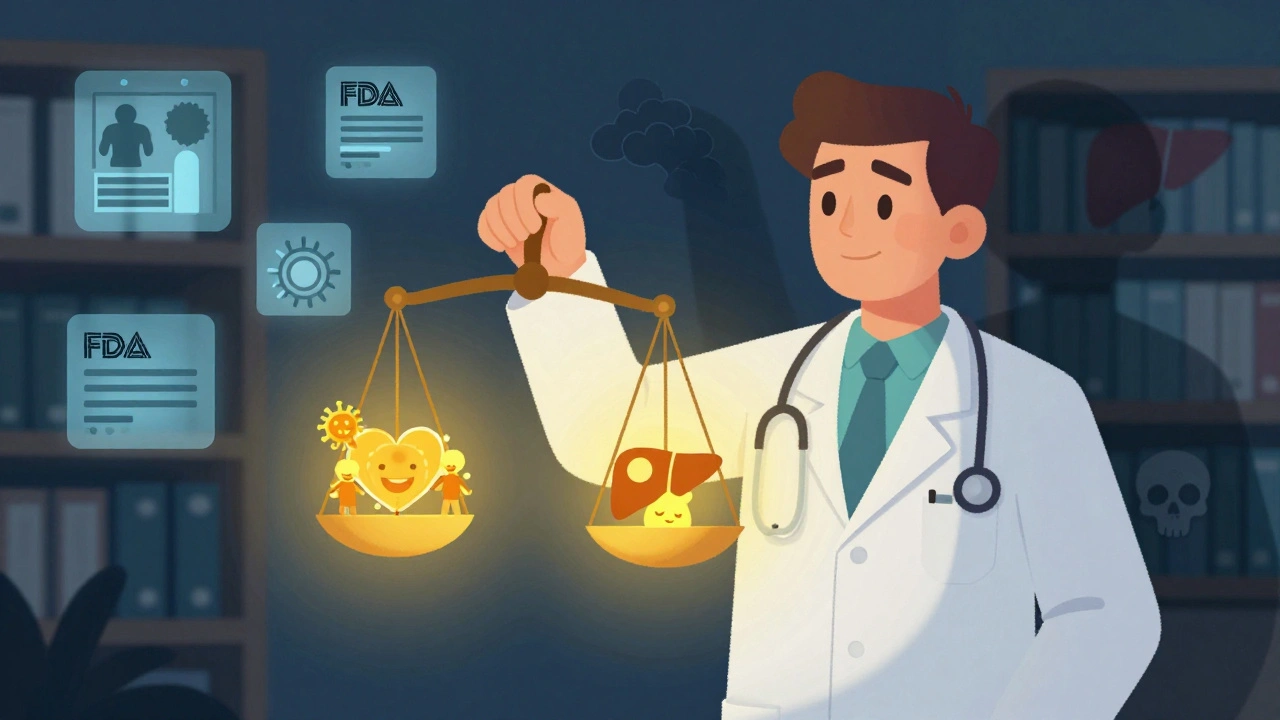
Medication Benefit-Risk Calculator
How to Use This Calculator
Enter your treatment scenario to see how healthcare providers assess if medication benefits outweigh risks. Based on FDA's framework and patient-centered decision-making.
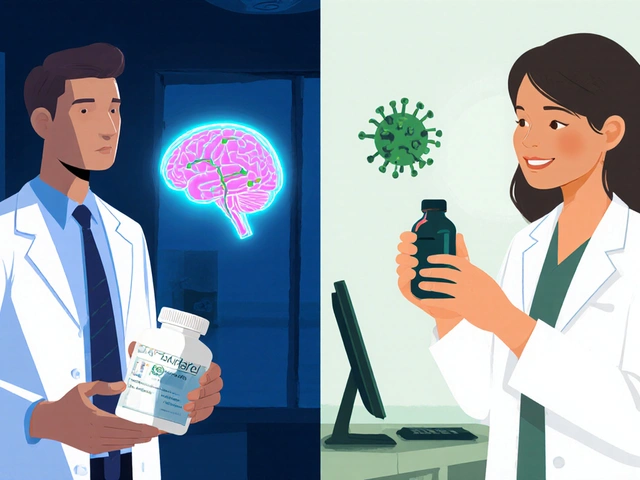
Every time a doctor prescribes a pill, they’re not just handing out a cure-they’re making a bet. On one side: relief from pain, lower blood pressure, or a fighting chance against cancer. On the other: nausea, liver damage, or even a rare but deadly reaction. This isn’t guesswork. It’s a structured, science-backed process called benefit-risk assessment, and it’s the reason some powerful drugs get approved while others don’t-even when they work.
It’s Not About Avoiding Side Effects-It’s About Managing Trade-Offs
People often think doctors should only prescribe drugs with zero side effects. But that’s impossible. All medications carry some risk. Even aspirin can cause internal bleeding. The question isn’t whether a drug has side effects-it’s whether the benefit is worth the risk for this person, right now. Take a drug like Keytruda for metastatic melanoma. About 40% of patients get serious immune-related side effects-rashes, colitis, even lung inflammation. But without it, only 10% of these patients live five years. With it? That jumps to 35%. For many, that’s not a hard choice. Doctors don’t just look at numbers-they explain what those numbers mean in real life: “This treatment gives you a shot at seeing your kids graduate. The side effects are scary, but they’re often manageable.”The FDA’s Framework: How Decisions Are Made
In the U.S., the Food and Drug Administration (FDA) doesn’t just approve drugs because they work. They approve them only if the benefits clearly outweigh the risks. Their official Benefit-Risk Framework breaks this down into four parts:- Condition: How serious is the disease? A life-threatening cancer is treated differently than seasonal allergies.
- Current treatments: What’s already available? If nothing else works, a riskier drug becomes more acceptable.
- Benefits: How well does it work? Is it a 70% tumor shrinkage? A 50% drop in hospital visits?
- Risks: What side effects happen? How often? Are they reversible? Could they cause long-term damage?
Different Rules in Different Places
The U.S. and Europe don’t always see things the same way. In 2020, the FDA approved 59 new drugs. The European Medicines Agency (EMA) approved 45. Why the difference? The FDA is more willing to accept higher risks for drugs that treat serious, life-limiting diseases. For example, Zolgensma-a gene therapy for spinal muscular atrophy-costs $2.1 million and can cause severe liver damage. But without it, babies with this condition die before age two. The FDA approved it. The EMA approved it too-but only after requiring strict monitoring. The EMA uses more numbers and formulas. The FDA leans on expert judgment and patient input. Both systems have strengths. But the FDA’s approach has one big advantage: it listens to patients.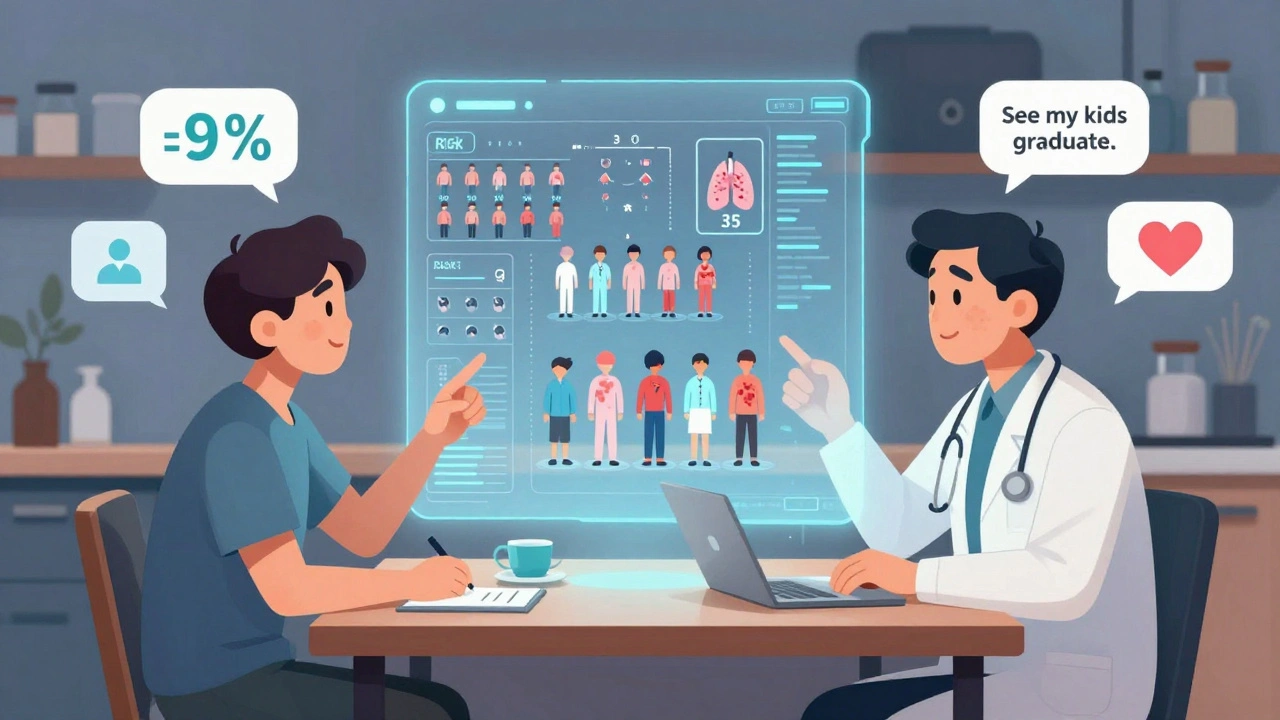
Patients Don’t Think Like Doctors
Doctors see risk in percentages. Patients see it in fear. A 2023 survey by the Michael J. Fox Foundation found that Parkinson’s patients were willing to accept a 20% risk of involuntary movements (dyskinesia) for a 30% improvement in mobility. Doctors thought patients would only accept a 12% risk. That’s a huge gap. Same with hypertension. A drug might cut stroke risk by 25%. But if there’s a 0.1% chance of swelling in the throat (angioedema), some patients refuse it-because the idea of choking to death feels worse than a stroke they might never have. That’s why the FDA launched Patient Decision Aids-simple tools that help explain risk in plain language. One tool showed patients: “Out of 100 people like you, 10 will get this side effect.” That simple shift cut non-adherence by 22% in pilot programs at Mayo Clinic and Johns Hopkins.Real-World Challenges
It’s not just about science. It’s about time, money, and bias. Primary care doctors spend 15 to 20 minutes per visit explaining risks and benefits. That’s nearly a third of a typical appointment. Many say it’s the hardest part of prescribing. And not everyone gets the same level of care. Clinical trials are still mostly made up of white patients-75% in 2023-while minorities make up 40% of the U.S. population. That means we don’t always know how a drug affects Black, Hispanic, or Indigenous patients. A side effect that shows up in one group might be missed in another. That’s not just unfair-it’s dangerous. Plus, some drugs are approved based on small, short-term studies. Real-world effectiveness often drops 20-30% once the drug hits millions of people. That’s why the FDA now uses electronic health records to track outcomes after approval-something called real-world evidence.
What’s Changing Now
The future of medication decisions is personal. By 2030, experts predict 70% of benefit-risk assessments will use individual data: your genes, your lifestyle, your other medications, even your gut microbiome. That means two people with the same diagnosis might get completely different drugs-not because one is sicker, but because their bodies react differently. Pharmaceutical companies are already using AI to predict side effects before a drug even hits the market. Roche’s ARIA platform cut unexpected safety issues by 30% in trials. And regulators are starting to ask: “What matters most to the patient?” Instead of just asking doctors, they’re asking people living with the disease. In rare diseases, patient preference studies now directly influence drug labeling-meaning if patients say they’d accept more risk for more function, that gets written into the official guide for doctors.Why This Matters to You
If you’re taking a medication, you’re part of this system. You don’t need to understand regulatory frameworks-but you do need to understand your own trade-offs. Ask your doctor:- What’s the chance this will actually help me?
- What are the most common side effects-and how bad are they?
- Is there another option with fewer risks?
- What happens if I don’t take it?
What’s Next
The system isn’t perfect. But it’s getting better. More patient input. Better data. More personalization. The days of one-size-fits-all prescriptions are fading. The future is about matching the right drug to the right person at the right time-balancing hope with honesty, science with humanity.Why do doctors prescribe drugs with serious side effects?
Doctors prescribe drugs with serious side effects when the condition being treated is severe and has few alternatives. For example, in advanced cancer or rare genetic diseases, the risk of not treating the illness is often much greater than the risk of side effects. The decision is based on whether the expected benefit-like extending life or restoring function-outweighs the potential harm.
Are side effects always listed in the drug information?
Yes, all known side effects from clinical trials must be listed in the official prescribing information. But some rare or long-term effects may not appear until the drug is used by millions of people after approval. That’s why post-market monitoring is critical-and why doctors keep watching patients even after the first prescription.
Can I refuse a medication because of side effects?
Absolutely. You have the right to refuse any medication. But it’s important to discuss alternatives first. Sometimes a different drug in the same class has fewer side effects. Other times, lifestyle changes or monitoring can reduce risk. Never stop a prescribed medication without talking to your provider-they may need to adjust your plan safely.
Why do some drugs get approved faster than others?
Drugs for life-threatening conditions with no good alternatives can get accelerated approval based on early data. This is common in cancer, rare diseases, and during public health emergencies. But these drugs still require ongoing safety studies after approval. Speed doesn’t mean less safety-it means the risk of waiting is seen as greater than the risk of the drug itself.
Do patients and doctors always agree on what risks are acceptable?
No. Patients often value symptom relief more than longevity, while doctors focus on survival rates. For example, Parkinson’s patients are willing to accept more movement problems for better daily function, but clinicians tend to underestimate that tolerance. That’s why patient input is now part of the approval process-so decisions reflect real priorities, not just clinical data.
December 5, 2025 AT 07:38 AM
Honestly, I wish more doctors just sat down and talked like this. No jargon, no rush. I had a drug that made me feel like a zombie, but no one ever explained the trade-off. When they did, I felt like an adult, not a patient.
Just saying: empathy isn't optional in medicine.
December 5, 2025 AT 20:37 PM
Oh wow, so now we’re pretending Big Pharma isn’t just selling hope wrapped in a clinical trial? Sure, the math looks good. But who’s paying for the liver transplants when the ‘manageable’ side effects turn permanent?
December 6, 2025 AT 05:38 AM
They don’t tell you this, but every drug approval is a bet made by people who’ve never taken the damn thing. The FDA? A revolving door of ex-pharma execs. The ‘benefit-risk’ framework? A PR pamphlet to make you feel safe while they sell you poison labeled ‘innovation.’
My cousin died on a ‘life-saving’ drug. The label said ‘rare.’ Turns out, rare means ‘we didn’t test it on people who look like us.’
December 7, 2025 AT 19:11 PM
I’ve been researching this for years and let me tell you - the entire pharmaceutical industry is built on controlled chaos. They test drugs on 500 people for 6 months, then release them to 20 million. Of course side effects show up later - they’re not looking for them. The FDA’s ‘real-world evidence’? A joke. It’s just them scrambling after the damage is done. And don’t get me started on how they ignore genetic differences in minorities. This isn’t science. It’s gambling with human lives and calling it ‘progress.’
They’ll say ‘it’s better than nothing,’ but what if nothing was the better option? What if the real benefit was not taking the pill at all? Nobody asks that. Because then the whole system collapses.
December 7, 2025 AT 21:05 PM
The fact that you need a 15-minute lecture just to understand why you’re being prescribed a pill is a systemic failure. This isn’t healthcare - it’s risk management disguised as medicine. And the patients? Just data points with a pulse. The real innovation here isn’t the drugs - it’s the ability to make people feel guilty for wanting to live without being turned into a side effect.
December 8, 2025 AT 13:15 PM
I used to think doctors were saints. Then I saw how they hand out prescriptions like candy while scrolling through their phones. The ‘benefit-risk’ talk? It’s a script. They’ve memorized it. They don’t care if you’re scared. They just want to check the box so they can move to the next patient. And the AI tools? Just fancy buzzwords to make the pharma execs look smart while the rest of us pay for it with our livers and our peace of mind.
Also - 75% white in trials? That’s not a gap. That’s a genocide by statistics.
December 9, 2025 AT 10:41 AM
I’ve been on a few of these meds. The scariest part wasn’t the side effects - it was the silence. No one ever says, ‘This might not work for you.’ They say, ‘Try it.’ And if it breaks you? Well, there’s another one.
But I’ve also had doctors who sat with me for 45 minutes, drew diagrams, asked what I valued most - and didn’t push. Those are the ones I trust. Not the ones with the fancy frameworks. The ones who treat you like a person.
December 9, 2025 AT 18:09 PM
You know what’s tragic? People think this is about science. It’s not. It’s about money. Every ‘personalized medicine’ push? It’s just pharma’s way of charging $2 million for a one-time gene therapy while the rest of us get generic pills that make us nauseous. And don’t get me started on how they use ‘patient input’ to greenlight drugs they already know are dangerous - because if the patients say ‘I’ll take the risk,’ then they can’t be sued, right? 😔
Wake up. This isn’t healthcare. It’s a subscription service for suffering.
December 10, 2025 AT 11:44 AM
This is why I started teaching patients how to ask the right questions. You don’t need to be a doctor - you just need to know what to ask. ‘Will this help me live better or just live longer?’ ‘What’s the worst that could happen - and how likely is it?’ ‘Is there a cheaper, safer option?’
You’re not powerless. You’re just not trained. And that’s on us - the system. But you can still fight back. Start with one question. Then another. You’ll be surprised how much changes when you stop being quiet.
December 10, 2025 AT 14:17 PM
I work in a clinic. I’ve seen the numbers. I’ve also seen the tears. The truth? Most patients don’t care about percentages. They care about whether they’ll be able to hold their grandkid again. Whether they’ll get to see the sunrise next week. The science is important - but it’s the human part that matters most. The best doctors? They don’t just explain risk. They sit with it. And they let you feel it without rushing you.
So if you’re on a med and it feels wrong? Speak up. You’re not being difficult. You’re being human.