

When someone starts taking an antipsychotic medication, the focus is usually on calming hallucinations, reducing delusions, or stabilizing mood. But there’s another, quieter battle happening inside the body-one that can lead to weight gain, diabetes, and heart disease if left unchecked. Antipsychotics, especially the newer ones, are incredibly effective for serious mental illnesses. Yet they come with a hidden cost: a sharp rise in metabolic problems that many patients-and even some doctors-don’t see coming until it’s too late.
Why Some Antipsychotics Are More Dangerous Than Others
Not all antipsychotics are created equal when it comes to metabolic risk. The older drugs, called first-generation antipsychotics (FGAs), mostly caused movement problems like tremors and stiffness. The newer second-generation antipsychotics (SGAs), introduced in the 1990s, were supposed to fix that. And they did-but they introduced a different kind of trouble.
Drugs like olanzapine and clozapine are among the most effective for treatment-resistant schizophrenia. But they’re also the worst offenders when it comes to weight gain. In one major study, patients on olanzapine gained an average of 2 pounds per month. By the end of 18 months, 30% had gained so much weight it became a health crisis. That’s not a side effect-it’s a predictable outcome for many.
On the other end of the spectrum, ziprasidone, lurasidone, and aripiprazole show much milder effects on weight and blood sugar. Patients on these medications rarely see major metabolic shifts. The difference isn’t subtle-it’s life-changing. Choosing one drug over another can mean avoiding diabetes, or not.
How These Drugs Mess With Your Body
It’s not just about eating more or moving less. These medications interfere with how your body handles energy at a cellular level. They disrupt signals in the brain that control hunger and fullness. They make fat cells store more fat, even if your calorie intake stays the same. They mess with insulin production in the pancreas and how your muscles absorb sugar. Some even affect liver function, leading to higher triglycerides and cholesterol.
What’s scary is that these changes start before you notice weight gain. Blood sugar can rise. Triglycerides can climb. Blood pressure can creep up-all while the person still looks the same. That’s why waiting until you’ve gained 20 pounds to check your health is already too late.
The Numbers Don’t Lie
People with schizophrenia or bipolar disorder already have a higher risk of metabolic syndrome than the general population. But add an SGA into the mix, and that risk jumps threefold. Studies show that between 32% and 68% of people on these medications develop metabolic syndrome. In the general public? Just 3.3% to 26%.
Metabolic syndrome means having at least three of these five things:
- Waist size over 40 inches for men, 35 inches for women
- Triglycerides above 150 mg/dL
- HDL (good) cholesterol below 40 mg/dL (men) or 50 mg/dL (women)
- Blood pressure at or above 130/85 mmHg
- Fasting blood sugar of 100 mg/dL or higher
If you have this combo, your risk of heart attack or stroke triples. And the damage doesn’t stop there. People with metabolic syndrome die on average 6.9 years earlier than those without it.
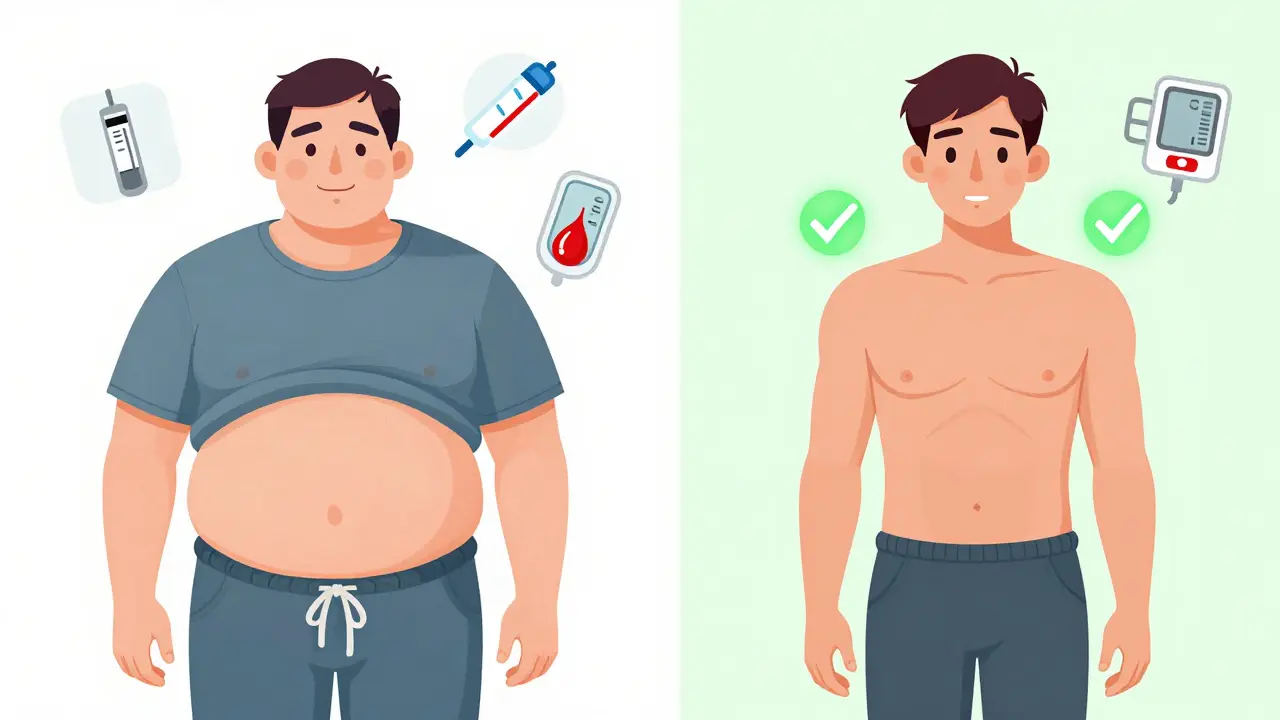
Monitoring Isn’t Optional-It’s Essential
Guidelines from the American Psychiatric Association, the American Diabetes Association, and Australian health authorities all agree: every patient on antipsychotics needs regular metabolic checks. Yet too many skip them.
Here’s what you need, and when:
- Before starting: Measure weight, BMI, waist circumference, blood pressure, fasting glucose, and lipid panel (cholesterol and triglycerides).
- At 4 weeks: Check weight and blood pressure. A sudden jump here is a red flag.
- At 12 weeks: Repeat glucose and lipid tests. This is when many early metabolic changes become clear.
- At 24 weeks: Full repeat of baseline tests.
- After that: Every 3 to 12 months, depending on risk.
Even if you feel fine, even if your weight hasn’t changed, these tests matter. The damage is happening under the surface.
What to Do If Risks Show Up
Let’s say your fasting glucose is 115 mg/dL and your triglycerides are 210. You’re not diabetic yet, but you’re on the edge. What now?
First, don’t panic. Don’t stop your medication. Work with your doctor. Here are your options:
- Lifestyle changes: A structured diet and exercise program can reverse early metabolic changes. Even losing 5% of body weight improves insulin sensitivity. No need for extreme diets-just consistent movement and fewer sugary drinks.
- Medication adjustments: If you’re on olanzapine or clozapine and your numbers are climbing, switching to a drug with lower metabolic risk (like aripiprazole or lurasidone) is often possible. It’s not a failure-it’s smart management.
- Targeted treatments: If blood sugar is high, metformin can help. If cholesterol is out of control, statins may be needed. These aren’t add-ons-they’re part of the treatment plan.
And yes, long-acting injections (LAI) don’t reduce metabolic risk. If you’re on an LAI version of olanzapine, you still need the same monitoring as someone taking pills.

The Hard Truth About Adherence
Why do so many people stop taking their meds? Weight gain. It’s the number one reason. One study found 20% to 50% of patients discontinue antipsychotics because of metabolic side effects. And when they stop, relapse follows. Psychosis returns. Hospital visits spike. It’s a vicious cycle.
The solution isn’t to ignore the weight gain. It’s to address it early-with real support. Patients need access to nutritionists, exercise programs, and mental health teams who understand both the mind and the body. Treating psychosis isn’t just about calming voices. It’s about keeping the heart healthy.
What’s Still Unknown
Scientists are still trying to figure out why some people gain weight on these drugs and others don’t. Is it genetics? Gut bacteria? Mitochondrial dysfunction? Early research suggests olanzapine and clozapine might damage the energy-producing parts of cells, making fat storage easier. But we don’t have answers yet.
What we do know is this: the longer you’re on a high-risk antipsychotic without monitoring, the higher your chance of developing serious, irreversible health problems. And those problems don’t just affect quality of life-they shorten it.
This isn’t about scaring people away from treatment. It’s about making treatment safer. Antipsychotics save lives. But they can also harm them-if we don’t pay attention to what’s happening inside the body.


March 16, 2026 AT 07:13 AM
I started on olanzapine last year and gained 38 pounds in 6 months. My doctor said it was 'just water weight.' I didn't believe him until my A1C hit 6.4. Now I'm on aripiprazole and have lost 22 pounds just by walking daily. No magic, just consistency. If you're on a high-risk med, don't wait for the scale to scream at you.
March 17, 2026 AT 02:08 AM
People act like this is some groundbreaking revelation. We've known this since the 2000s. The pharmaceutical companies pushed these drugs hard because they're profitable. Doctors got lazy. Patients got sacrificed. Wake up. This isn't a medical issue-it's a corporate one.
March 18, 2026 AT 02:36 AM
I've been on clozapine for 11 years. My triglycerides are 420. My BP is 148/92. I've tried everything-keto, intermittent fasting, yoga, personal trainers. Nothing sticks because the drug itself is rewiring my metabolism. I don't blame the system. I blame the science. We need better drugs, not better monitoring. Monitoring is a bandaid on a severed artery. I wish someone had told me this before I started. Now I'm just trying to survive the aftermath.
March 19, 2026 AT 13:08 PM
Oh wow, a doctor actually wrote something useful for once. Who knew the psychiatric community could be this transparent? I'm sure the pharmaceutical reps are thrilled. Still, I'm impressed they didn't bury this in a 300-page pamphlet only available in Latin. Progress, I guess.
March 21, 2026 AT 07:39 AM
The guidelines are clear. Get tested before you start. Check at 4 weeks. That's it. No excuses. If your doc doesn't push this, find a new one. Your life is worth more than their convenience.
March 22, 2026 AT 07:36 AM
I'm on lurasidone and my weight stayed the same. My doc just said 'try this' and it worked. No drama. No panic. Just smart choices. Why is this so hard for others?
March 23, 2026 AT 02:39 AM
There's a deeper layer here. We treat the mind as separate from the body. But the body is the mind's vessel. When we ignore metabolic health, we're not just neglecting physical health-we're undermining the very foundation of mental stability. A diabetic brain doesn't heal the same way. The soul doesn't care about your HbA1c, but your neurons do.
March 24, 2026 AT 06:39 AM
In India, we don't even have access to these drugs properly. Why are you Americans so obsessed with monitoring? We're just happy to have any antipsychotic at all. Stop being so privileged. Your problems are first-world. We're just trying to survive.
March 26, 2026 AT 05:29 AM
I read this whole thing. Then I Googled 'olanzapine weight gain Reddit.' Got 12,000 results. Half of them are people who quit meds and went psychotic. So what's the answer? Don't take them? Or take them and die slowly? Either way, we're screwed.
March 28, 2026 AT 02:39 AM
The tragedy isn't the weight gain. It's the silence. The way doctors look away when patients say 'I feel bloated.' The way families whisper 'she's just lazy' instead of asking 'did they check her lipids?' This isn't medicine. It's negligence dressed in a white coat.
March 29, 2026 AT 04:26 AM
I stopped taking mine because I couldn't look in the mirror anymore. My mom said 'it's just a side effect.' But side effects don't make you cry in the shower every night. I'm not sorry I quit. I'm sorry no one warned me it would feel like losing myself.
March 30, 2026 AT 14:06 PM
This is why integrated care models are non-negotiable. Psychosis + metabolic syndrome = dual diagnosis that requires dual expertise. We need psychiatrists who collaborate with endocrinologists. Nurses trained in metabolic monitoring. Pharmacies that auto-flag high-risk scripts. It's not rocket science-it's basic systems design. We know how to fix this. We just haven't funded it.
March 31, 2026 AT 03:28 AM
I'm on ziprasidone. No weight gain. Stable glucose. My doctor said 'you're lucky.' I'm not lucky. I'm informed. I asked questions. I demanded tests. You can too. 📊🩸
April 2, 2026 AT 02:17 AM
Let me get this straight: we have a class of drugs that can save someone from psychosis… but also destroy their heart, liver, and pancreas… and we call this 'treatment'? It's not treatment-it's a high-stakes gamble with your organs. And the worst part? The patients are the ones who lose. The doctors get paid. The pharma companies get rich. The system? It's working exactly as designed.