
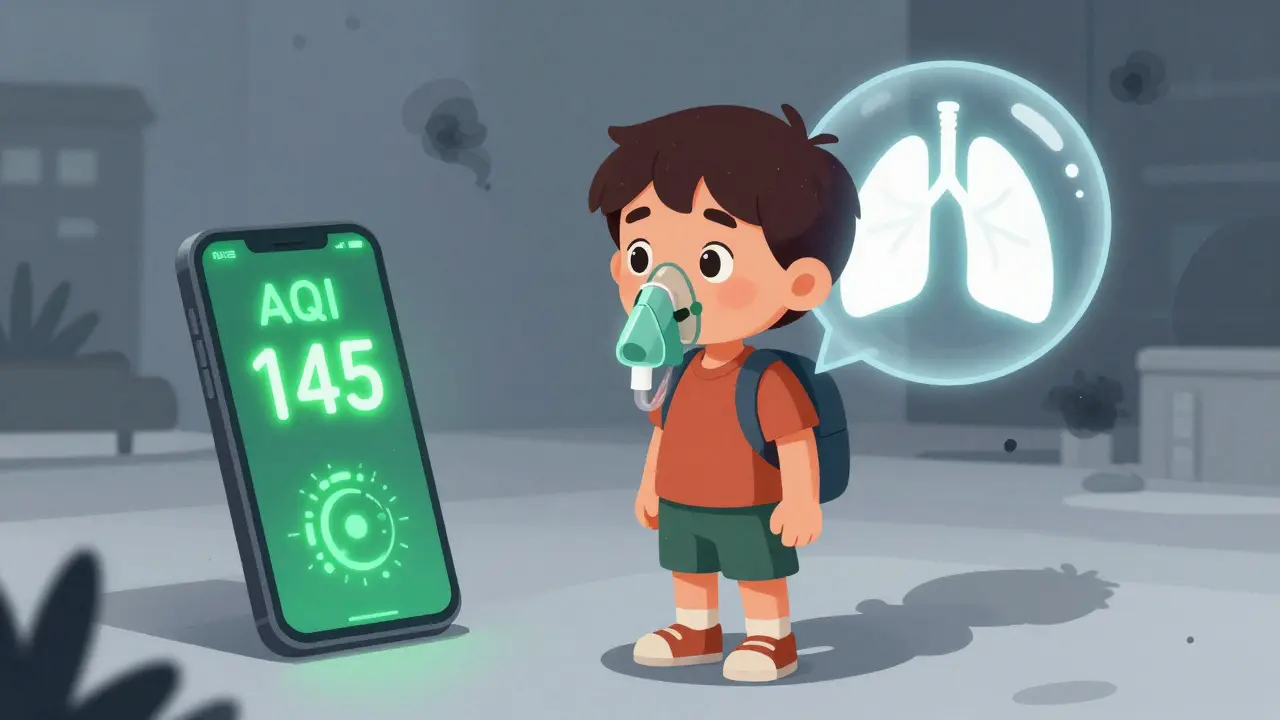
Every year, millions of people with asthma struggle to breathe because of something they can’t see or control: dirty air. If you or someone you love has asthma, you’ve probably noticed how bad days feel worse when the sky looks hazy, the smell of smoke lingers, or traffic is heavy outside. It’s not just coincidence. Air pollution doesn’t just irritate your lungs-it triggers asthma attacks, increases emergency room visits, and makes daily life harder. The good news? You don’t have to wait for governments to fix everything. There are real, science-backed ways to reduce your exposure right now-and they work.
How Air Pollution Makes Asthma Worse
Asthma is already a condition where the airways get swollen and tight. When pollutants like PM2.5, nitrogen dioxide, or ozone get inhaled, they act like gasoline on a fire. These tiny particles and gases cause inflammation, make mucus thicker, and trigger bronchospasms. The result? More wheezing, more coughing, more reliance on rescue inhalers.
Research from 2024 shows that even small spikes in pollution can push asthma control scores down. One study tracked people using mobile alerts for air quality and found their Asthma Control Test (ACT) scores jumped from 20.0 to 21.5 over just eight weeks when they avoided high-pollution days. That’s not just a number-it means fewer missed school days, less nighttime waking, and fewer trips to the ER.
During the pandemic lockdowns, when traffic and industry slowed, asthma symptoms improved across the board. Hospital visits dropped by nearly 40% in some cities. That’s proof that cleaner air = better breathing. And it’s not just adults. A 2019 study in The Lancet Planetary Health found that air pollution causes 4 million new cases of childhood asthma every year globally. Kids are especially vulnerable because their lungs are still developing.
Check the Air Quality Index (AQI)-Before You Step Outside
You don’t need a fancy device to know when it’s unsafe to go out. The EPA’s AirNow.gov gives free, real-time AQI readings for almost every U.S. city and many international locations. The scale is simple:
- AQI 0-50: Good. No restrictions.
- AQI 51-100: Moderate. Sensitive groups (including asthma patients) should cut back on long outdoor workouts.
- AQI 101-150: Unhealthy for sensitive groups. Everyone with asthma should avoid prolonged outdoor activity.
- AQI 151-200: Unhealthy. Avoid all outdoor exertion.
- AQI 201-300: Very unhealthy. Stay indoors. Close windows.
Apps like AirVisual, Plume Labs, or BreezoMeter send alerts when pollution spikes. One user in Sydney told me she started using AirVisual after her son had three asthma attacks in two weeks. Within six months, his rescue inhaler use dropped by 45%. She didn’t change his medication-she just changed when he played outside.
Make Your Home a Clean Air Sanctuary
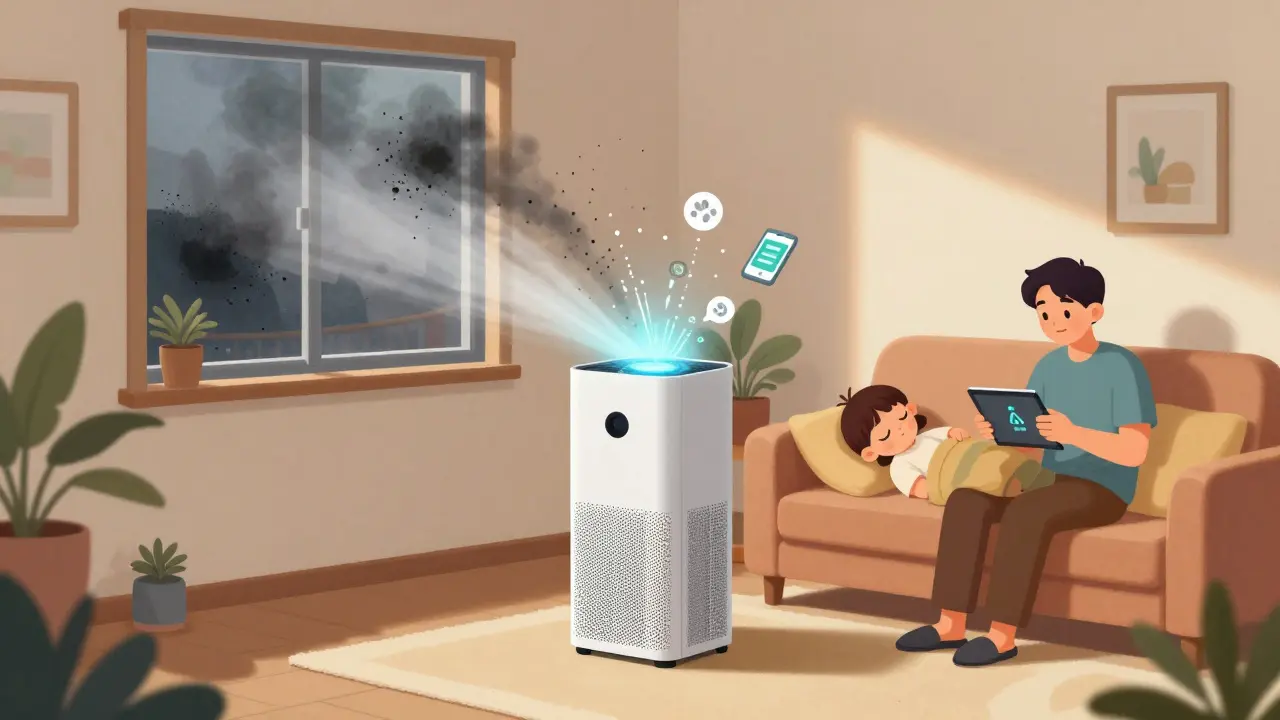
Indoor air can be just as bad-or worse-than outdoor air. Cooking, cleaning products, dust mites, and even candles release particles that trigger asthma. The best way to fix it? A good air purifier.
Look for one with a HEPA filter. That means it captures 99.97% of particles as small as 0.3 microns-exactly the size of most pollution particles and allergens. Don’t be fooled by marketing terms like “nano-filter” or “ionizer.” Only HEPA is proven. For best results, choose a purifier with a MERV 13-16 rating if it’s built into your HVAC system, or a portable unit with a Clean Air Delivery Rate (CADR) that matches your room size.
Example: For a 300-square-foot bedroom, you need a CADR of at least 200. A unit like the Coway Airmega 400 hits that mark and has been shown in studies to cut indoor PM2.5 by up to 67%. But here’s the catch: 72% of people place their purifiers against walls or behind furniture. That cuts effectiveness by 30-50%. Put it in the center of the room. Keep it running 24/7. Change the filter every 3-6 months. Only 43% of users do this on time, and that’s why many think purifiers “don’t work.” They just never gave them a fair shot.
Don’t Rely on Face Masks Alone
During wildfire season, you’ll see people wearing N95 masks everywhere. They’re better than nothing-but they’re not a magic shield. The CDC recommends them for short-term use during smoke events, but Dr. John Balmes from UCSF warns they can give a false sense of safety, especially for kids.
Why? N95s need a tight seal to work. Most people don’t fit them right. Beards, glasses, small faces-all break the seal. Even if you get it right, they don’t filter gases like ozone or NO2. And wearing one for hours while commuting or working? Uncomfortable. Not sustainable.
Use N95s only for unavoidable outdoor exposure: walking to the car, running a quick errand. Don’t wear them all day. Focus instead on keeping indoor air clean and avoiding outdoor time when pollution is high.
Policy-Level Changes Are Working-And You Can Help
Individual actions matter, but they have limits. Even with windows closed and a HEPA filter running, indoor PM2.5 can still hit 60-80% of outdoor levels during a wildfire. That’s why systemic change is critical.
Here’s what’s working:
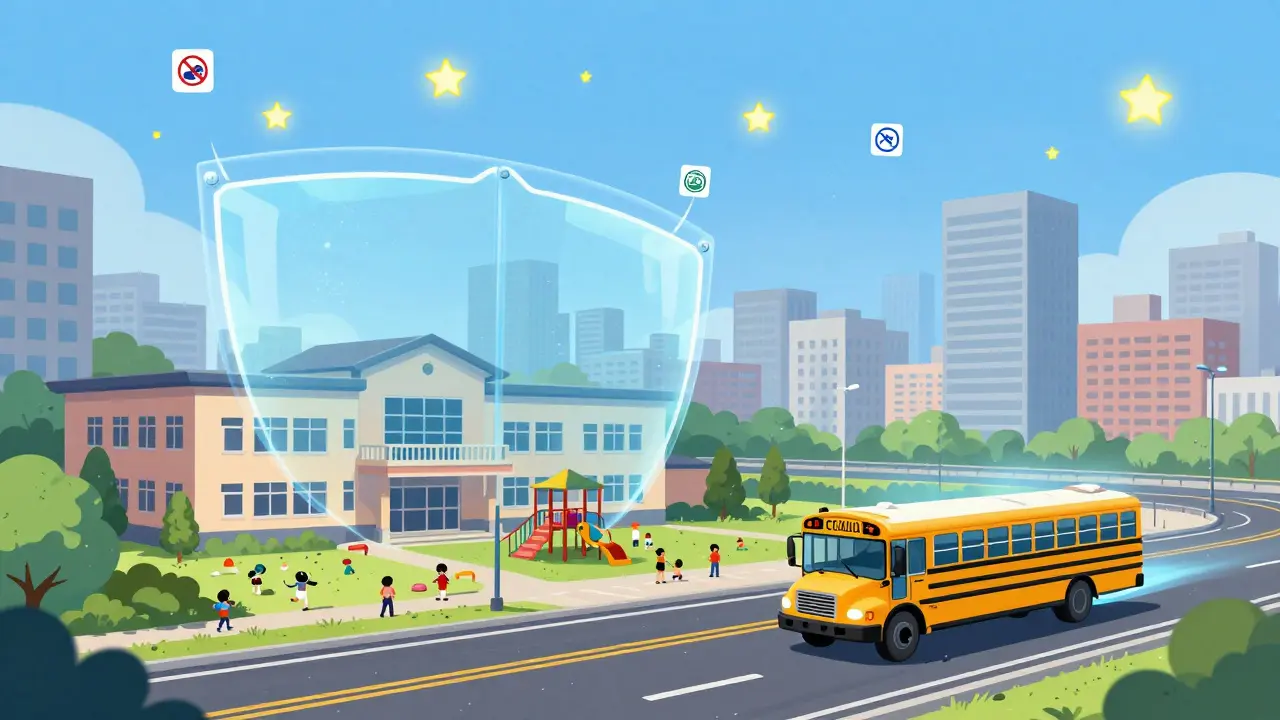
- Electric school buses: California is replacing all diesel buses with electric ones by 2035. Early data shows a 60% drop in children’s exposure to traffic pollution near schools.
- School siting rules: 47 U.S. cities now require new schools to be built at least 500 feet from major roads. One Massachusetts school moved its playground away from a highway and saw a 35% drop in indoor PM2.5.
- Anti-idling policies: Schools and daycare centers that ban car idling near entrances reduced children’s pollution exposure by 22-35%.
- Ultra Low Emission Zones: London’s zone cut childhood asthma hospitalizations by nearly 12% in two years.
The EPA is also moving to tighten the annual PM2.5 standard from 12 μg/m³ to 9-10 μg/m³. But the American Thoracic Society says even that’s not enough-they recommend 8 μg/m³. You can write to your local representative, support clean transit initiatives, or vote for candidates who prioritize air quality. Real change happens when people demand it.
What Works Best? A Layered Approach
There’s no single fix. The most effective strategy combines multiple tools:
- Monitor: Use AQI apps daily.
- Limit: Reduce outdoor time when AQI is above 100.
- Filter: Run a HEPA purifier in bedrooms and living areas.
- Seal: Close windows during high pollution events, especially near busy roads.
- Advocate: Push for cleaner schools, public transit, and stronger air standards.
A 2023 study from the Massachusetts Asthma Action Partnership found that people who used three or more of these strategies had 50% fewer asthma flare-ups than those who used only one. It’s not about perfection-it’s about stacking small wins.
Barriers Are Real-But Not Impossible to Overcome
Let’s be honest: not everyone can afford a $700 air purifier. Not everyone can quit their outdoor job. Not every school has the budget to move playgrounds.
But here’s what does work:
- Free AQI apps work on any phone.
- HEPA filters start at $50-some hospitals and clinics give them away for free to high-risk patients.
- Wearing a mask for 10 minutes while walking to the bus is better than nothing.
- Asking your child’s school to ban idling takes one email.
A 2022 survey found that 68% of asthma patients check air quality-but only 32% change their behavior. The top reasons? Work (78%), childcare (65%), and cost (52%). If you’re one of them, start small. Pick one thing. Do it consistently. That’s how lasting change begins.
What’s Next? The Future Is Personalized
The NIH is now funding pilot programs that link air pollution data directly to electronic health records. Imagine your doctor seeing not just your inhaler use, but also your daily exposure levels-and adjusting your treatment plan automatically.
Wearable sensors are being tested to give kids real-time alerts when pollution spikes. Machine learning models are predicting bad air days before they happen. This isn’t sci-fi-it’s happening now.
But none of it matters if we don’t keep pushing for cleaner air. The science is clear. The tools exist. The question isn’t whether we can reduce asthma triggers-it’s whether we’ll choose to.
Can air purifiers really help with asthma?
Yes, when used correctly. HEPA air purifiers that match your room size can reduce indoor PM2.5 by 55-67%, which directly lowers asthma symptoms. But they only work if you run them continuously, place them in the center of the room, and replace filters every 3-6 months. Many people buy them and then don’t maintain them-so they think they don’t work.
Is it safe to exercise outside if I have asthma?
It depends on the Air Quality Index (AQI). At AQI 51-100, limit prolonged outdoor activity. At AQI 101 or higher, avoid outdoor exercise entirely. Morning hours are often cleaner than afternoon, especially in cities. Consider indoor workouts on high-pollution days. Even 20 minutes of walking on a bad day can trigger symptoms.
Do N95 masks protect against all types of air pollution?
No. N95 masks filter out fine particles like PM2.5, but they don’t block gases like ozone, nitrogen dioxide, or sulfur dioxide-both common asthma triggers. They also require a perfect seal to work, which many people, especially children, can’t achieve. Use them only for short, unavoidable outdoor exposure-not as a daily solution.
How does air pollution affect children with asthma differently?
Children’s lungs are still developing, making them more vulnerable. They breathe faster than adults, taking in more air-and more pollutants-per pound of body weight. Studies show that kids exposed to high pollution are more likely to develop asthma and have more severe symptoms. School-based interventions like moving playgrounds away from roads or banning bus idling have cut asthma-related absences by up to 41%.
What’s the best way to track air quality in my area?
Use the free EPA AirNow.gov website or apps like AirVisual, Plume, or BreezoMeter. They show real-time AQI levels, forecasts, and alerts. For the most accurate readings, select your exact neighborhood-not just the nearest city. Some local health departments also offer free air quality sensors for high-risk households.
Can I reduce indoor pollution without buying expensive gear?
Absolutely. Keep windows closed during high pollution days. Avoid smoking indoors. Use exhaust fans when cooking. Vacuum weekly with a HEPA-filter vacuum. Switch to unscented cleaning products. Avoid candles and incense. These simple steps cut indoor pollutants significantly-and cost little to nothing.
If you’re managing asthma in a polluted world, you’re not powerless. Start with one change today-check the AQI before you leave the house. That’s the first step toward breathing easier, every day.


January 10, 2026 AT 13:25 PM
I started using AirVisual after my daughter’s third asthma scare last fall-and wow. Her inhaler usage dropped by half in three months. I didn’t change meds, I just stopped letting her play outside after 4 p.m. on bad days. Seriously, it’s like night and day. Don’t overthink it. Just check the app. Every. Single. Morning. 😍
January 10, 2026 AT 20:28 PM
HEPA filters are non-negotiable. I’ve seen too many people buy a $150 purifier, stick it behind the couch, and then complain it doesn’t work. If you’re going to do this, do it right. Center it. Run it 24/7. Change the filter. That’s not optional-it’s medical hygiene. Your lungs will thank you.
January 11, 2026 AT 20:07 PM
It is, frankly, a moral failure that we have allowed air pollution to become an acceptable risk for children. The science is not merely suggestive-it is unequivocal. To suggest that individuals should simply "check the AQI" is to absolve systemic culpability. We are not living in a vacuum, nor should we be expected to manage public health failures through consumer-grade appliances. The EPA’s proposed standard of 9 μg/m³ is a token gesture. The true benchmark is 8. And until we enforce it, we are complicit.
January 12, 2026 AT 02:19 AM
I live in Delhi, and trust me-I know what it’s like to wake up and feel like your lungs are full of ash. I used to think masks were enough. Then I got a cheap $60 HEPA purifier for my kid’s room. Not fancy. Not loud. Just works. Now he sleeps through the night. I didn’t need to wait for the government. I just needed to act. You can too. Start small. But start now.
January 12, 2026 AT 23:26 PM
My mom has asthma and she’s 72. She refuses to buy anything expensive. So I got her a $40 purifier from Target, put it next to her favorite chair, and set it to auto mode. She didn’t even notice it was there at first. Now she says she breathes easier while watching TV. Sometimes the best solutions are the quiet ones.
January 14, 2026 AT 01:15 AM
You people are missing the point entirely. Air purifiers don’t fix pollution-they just let you pretend it’s not happening. Real change means shutting down coal plants, banning diesel trucks, and holding corporations accountable. If you think a $700 machine makes you a hero, you’re part of the problem. The solution isn’t in your living room-it’s in the boardroom.
January 14, 2026 AT 01:34 AM
So let me get this straight. We’re supposed to believe that a $50 air filter is the answer to decades of environmental negligence? Brilliant. Next you’ll tell me to wear a tinfoil hat during wildfires. Meanwhile, the EPA’s standard is still 12 μg/m³ while kids are dying. But hey, at least your HEPA filter looks nice on Instagram.
January 14, 2026 AT 19:44 PM
I used to think this was all hype until my son had a near-fatal attack after a school field trip near a highway. We started using AirNow every morning. We stopped letting him ride the bus. We got a purifier. We banned candles. We didn’t change his meds. We changed his environment. And now he plays soccer without wheezing. It’s not magic. It’s math. Less exposure equals better outcomes. Simple.
January 16, 2026 AT 02:41 AM
This entire article is a liberal fantasy. Air pollution has decreased 60% since 1990 in the U.S. Meanwhile, asthma diagnoses have skyrocketed due to overdiagnosis, poor diet, and excessive hygiene. Blaming the air is convenient. It absolves parents of responsibility for their children’s health. Maybe stop letting kids sit in front of screens all day and get them outside for real fresh air.