
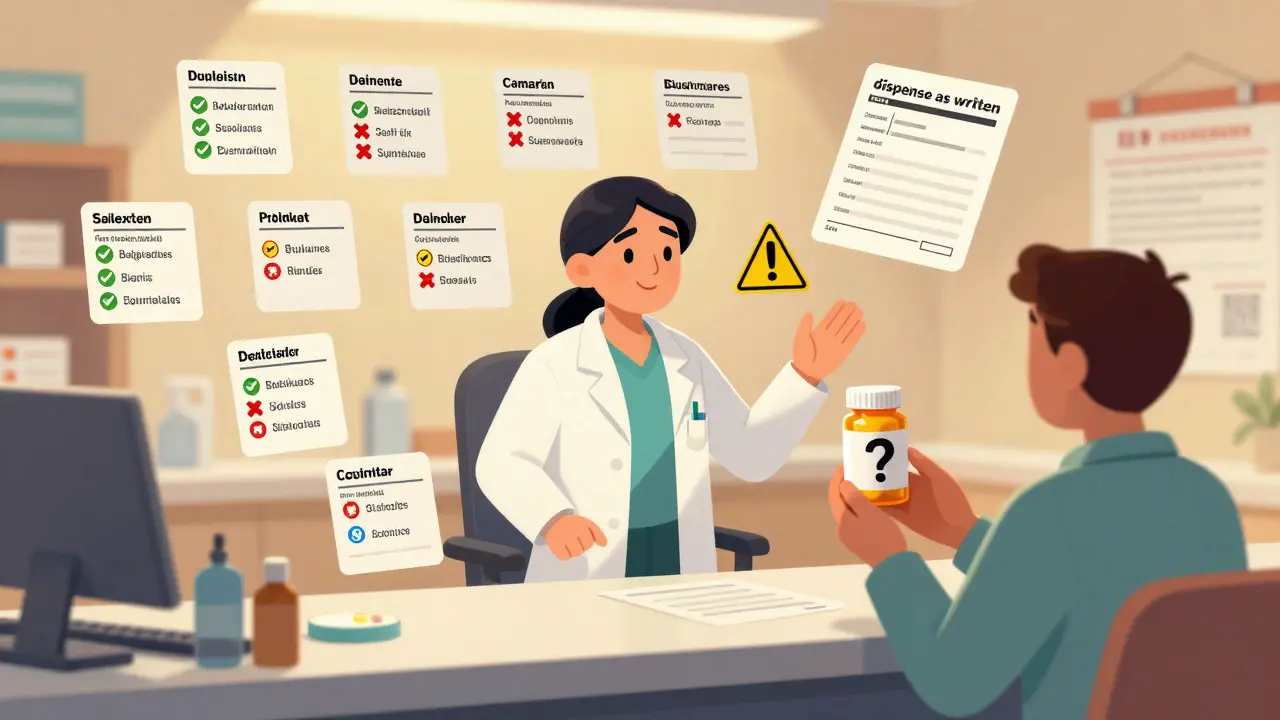
When you pick up a prescription, you might not think about whether the pill in your bottle is the brand name or a cheaper generic. But behind the counter, pharmacists are juggling a patchwork of 51 different sets of rules - one for each state and Washington, D.C. - that dictate exactly when, how, and if they can swap a brand-name drug for a generic version. This isn’t just paperwork. It affects your out-of-pocket costs, your safety, and even whether your doctor knows what you’re taking.
How Generic Substitution Works - And Why It Matters
Generic drugs are chemically identical to their brand-name counterparts. They work the same way, have the same side effects, and are held to the same FDA standards. The only real difference? Price. Generics cost, on average, 80-85% less. That’s why the federal government pushed for their use back in the 1980s with the Hatch-Waxman Act. Since then, generics have saved the U.S. healthcare system over $1.68 trillion in just ten years. But here’s the catch: even though the FDA approves generics as safe and effective, each state gets to decide whether pharmacists can automatically swap them in for brand-name drugs. Some states force the swap. Others say no unless you give permission. And some don’t even require you to know it happened.19 States Require Pharmacists to Substitute Generics
In 19 states, pharmacists are legally required to substitute a generic drug unless the prescriber writes “dispense as written” or the patient refuses. These are called mandatory substitution states. Examples include California, New York, Florida, and Illinois. In these places, the default is generic - unless someone explicitly says no. This approach drives up generic use. States with mandatory laws see 8.7% higher generic dispensing rates than states that leave it up to discretion. That translates to real savings: $1.2 billion a year in reduced drug costs, according to the Federal Trade Commission. But it also means pharmacists have less room to judge - even if they think a brand drug is better for a specific patient.31 States Plus DC Let Pharmacists Decide
The rest - 31 states and Washington, D.C. - operate under permissive substitution rules. That means pharmacists can swap a generic in, but they don’t have to. They can choose based on cost, availability, or even their own judgment. Some pharmacists in these states will always offer the generic unless asked otherwise. Others wait for the patient to bring it up. This system gives more control to the pharmacist, but it also creates inconsistency. One pharmacy might automatically switch your blood pressure med to a generic. The one down the street might not. Patients get confused. And prescribers often don’t know what’s being dispensed unless they check the records.What About Biosimilars? The Rules Get Even More Complex
Biosimilars are the generic version of biologic drugs - complex medications made from living cells, like insulin, rheumatoid arthritis treatments, or cancer therapies. Unlike small-molecule generics, biosimilars aren’t exact copies. They’re highly similar, but not identical. That’s why states treat them differently. As of 2025, 45 states require pharmacists to notify the prescribing doctor within a set timeframe after substituting a biosimilar. California demands electronic notification within five days. Other states require written notice or allow a 30-day window. In 38 states, patients must also be told about the switch. In 13, they don’t have to be told at all. And here’s the kicker: 90% of states have stricter rules for biosimilars than for regular generics. That means even if your state allows automatic substitution for a generic ibuprofen, it might require your doctor’s approval before swapping your biologic drug.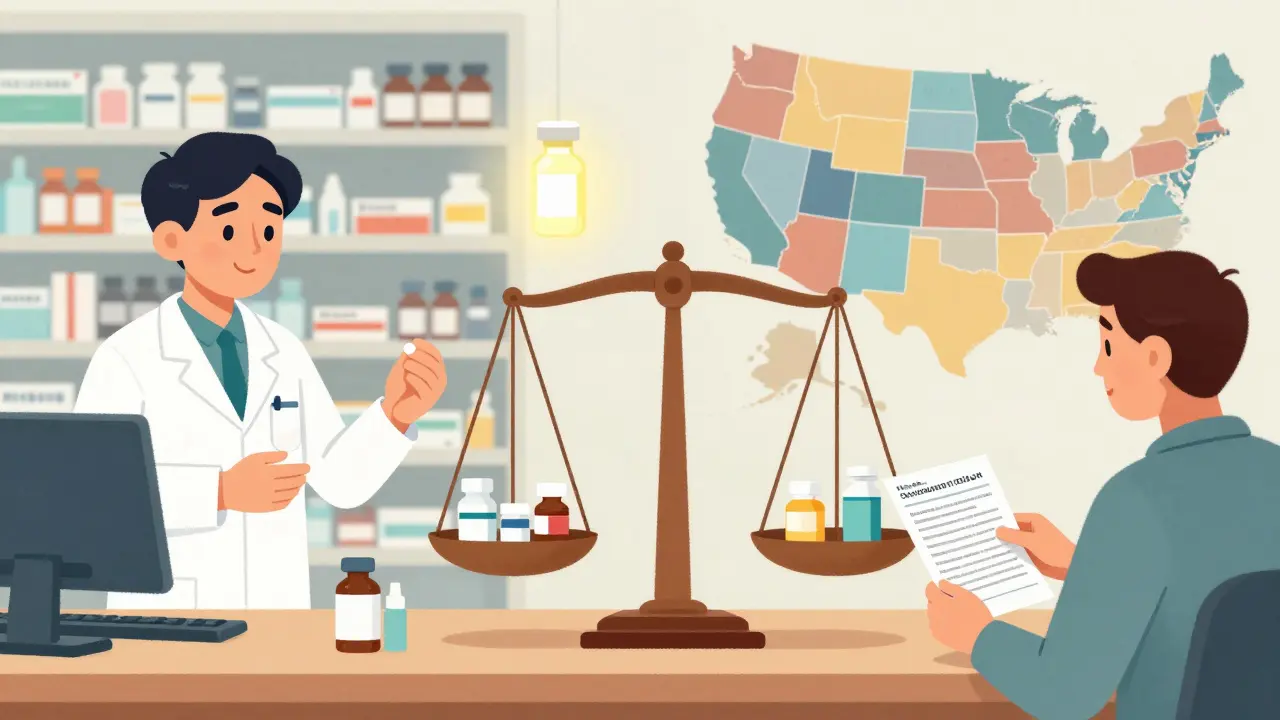
Who Gets to Say No? Patient Consent and Prescriber Control
Only seven states plus D.C. require the patient to give explicit consent before a generic substitution. That means in 43 states, you could get a different drug without ever being asked. That’s not always a bad thing - if you’re on a tight budget, automatic substitution saves money. But for high-risk medications like warfarin, thyroid meds, or epilepsy drugs, even tiny differences can matter. Prescribers have the final say in every state. They can write “dispense as written” or “do not substitute” on the prescription. That’s the most reliable way to block a swap. But many patients don’t know they can ask for this. And many prescribers don’t realize how often substitutions happen - especially in states without notification rules.Liability: Who Gets Sued If Something Goes Wrong?
Pharmacists are on the front line. If a substituted drug causes an adverse reaction, they could be held responsible. But in 24 states, there’s no clear legal protection for pharmacists who follow substitution rules. That means they’re left guessing: “Did I do this right? Could I be sued?” In Connecticut, one pharmacist told a local news outlet she refused to substitute warfarin - even though the generic was FDA-approved - because she didn’t have liability protection. That’s not rare. In states without clear protections, pharmacists are more likely to stick with the brand name, even if it costs the patient hundreds more.How States Decide What Can Be Substituted
The FDA’s Orange Book is the official list of approved generics and their therapeutic equivalence ratings. Most states use it as the gold standard. But 18 states go further. They add their own criteria - like requiring a certain manufacturer, limiting substitutions to specific pharmacies, or banning certain drugs from being swapped at all. Some states use a “positive formulary” - meaning they list which generics are allowed. Others use a “negative formulary” - listing which drugs cannot be substituted. Oklahoma is the only state that requires written authorization from either the prescriber or the patient’s insurance before any substitution can happen. That’s the strictest rule in the country.
Real-World Problems: Pharmacists Are Overwhelmed
The average pharmacist spends over eight hours a month just trying to keep up with substitution rules across different states. For those working in telepharmacy or multi-state chains, it’s worse. One pharmacist on Reddit said they spend 15-20 minutes per prescription checking state laws. A 2023 survey found that 41% of pharmacists made at least one substitution error in the past year - not because they were careless, but because the rules changed too often, weren’t clear, or didn’t sync with their electronic systems. Only 28 states have fully integrated substitution rules into major electronic health record platforms like Epic or Cerner. That means pharmacists still have to flip through PDFs, call state boards, or guess.What’s Changing in 2025?
There’s movement toward simplification. In 2024, the National Association of Boards of Pharmacy started a project to reduce 51 different state rules down to just three regional models by 2026-2027. Nine states passed laws in 2023-2024 to align their biosimilar rules with small-molecule generic rules. The FDA is pushing for national alignment too. Commissioner Robert Califf called state-by-state rules the “single greatest barrier” to biosimilar adoption. And the Congressional Budget Office estimates that if all states standardized their rules, we could save an extra $14.3 billion over ten years. But change is slow. Pharmacy chains spend an average of $1.2 million per state just to stay compliant. Independent pharmacies - which make up the majority - don’t have that kind of budget. That’s why they’re more likely to make errors.What You Should Do
You don’t need to memorize your state’s pharmacy laws. But you should know your rights:- Ask if a generic was substituted - even if you didn’t notice a difference.
- Request “dispense as written” if you’ve had bad reactions to generics before.
- Check your prescription label. If the name changed, ask why.
- If you’re on a high-risk medication (blood thinners, seizure meds, thyroid drugs), be extra vigilant.
- Call your pharmacy if you get a different-looking pill and weren’t told why.
Why This Matters Beyond Your Prescription
This isn’t just about pills. It’s about trust in the system. If patients don’t know what they’re taking - or if their doctors don’t either - it creates gaps in care. It leads to errors. It delays treatment. And it costs lives. The data shows: when substitution rules are clear, consistent, and transparent, people get better care at lower cost. When they’re messy and confusing, everyone loses. The system is broken - not because generics are unsafe, but because the rules are a maze. And until states start working together, pharmacists will keep spending hours on paperwork instead of helping patients. And patients? They’ll keep wondering what’s in their bottle - and whether it’s really the right one.Can a pharmacist substitute a generic drug without telling me?
Yes, in 20 states and D.C., pharmacists are not required to notify you before substituting a generic drug. In the remaining 31 states, they must inform you - either verbally, in writing, or electronically. Always check your prescription label and ask if you’re unsure.
Do I need to give consent before getting a generic drug?
Only in seven states and Washington, D.C. In those places, you must give explicit permission before a generic is dispensed. In the other 43 states, consent is not required - even if you’re switching from a brand-name drug to a generic version.
Are biosimilars treated the same as regular generics?
No. Biosimilars - which replace complex biologic drugs like insulin or cancer treatments - face stricter rules in 45 states. Most require the prescribing doctor to be notified within days, and many require patient notification too. Unlike regular generics, biosimilars are not automatically interchangeable in most places.
What does “dispense as written” mean on a prescription?
It means the prescriber is asking the pharmacist not to substitute the brand-name drug with a generic. This instruction overrides state substitution laws. If you see this on your prescription, you’ll get exactly what the doctor ordered - no swaps allowed.
Can I ask my pharmacist to use the brand-name drug instead of a generic?
Yes. You can always ask for the brand-name drug, even in mandatory substitution states. The pharmacist can still fill your prescription with the brand, but you may have to pay more out of pocket. Some insurance plans require you to try the generic first before covering the brand.
Why do some states have different rules for generic substitution?
Each state regulates pharmacy practice independently. There’s no federal law forcing uniformity. States have different priorities - some focus on cost savings, others on patient safety or pharmacist liability. This has created a patchwork of 51 different systems, making it hard for pharmacists and patients alike.
Is there a list of all 50 state rules I can check?
Yes. The National Association of Boards of Pharmacy (NABP) offers a free, updated online resource that maps all state substitution laws. However, many pharmacists say it lacks detail for complex cases, especially with biosimilars. For the most accurate info, always confirm with your state’s board of pharmacy.



December 15, 2025 AT 12:19 PM
I never realized how wild the patchwork of state rules is. Just last week I got a different pill and didn't think twice. Now I'm checking my labels like a hawk. 🙃
December 16, 2025 AT 14:16 PM
This is why I always ask my pharmacist. Not because I don't trust generics, but because I've had bad reactions before. A simple "dispense as written" saved my life. 💊❤️
December 18, 2025 AT 10:50 AM
India has one national rule and it works fine why cant u just do that. All this state nonsense is why ur system is broken. Pharma lobbyists love this chaos
December 19, 2025 AT 17:45 PM
I work in a pharmacy in Ohio and I can tell you the confusion is real. We get calls from patients who got a different pill and are panicked. We don't always know the rules either. It's not our fault.
December 19, 2025 AT 20:05 PM
Honestly I just assume the generic is fine unless I'm on something like warfarin. But now I'm wondering how many times I got switched without knowing. Kinda scary when you think about it.
December 20, 2025 AT 07:47 AM
It's not just about cost or safety. It's about trust. When the system feels random, people start doubting everything. Even if the science says generics are equal, the feeling of uncertainty lingers. And that matters more than we admit.
December 21, 2025 AT 00:44 AM
Americans can't even agree on pills. Meanwhile China and India standardize everything. This is why we dominate pharma. You're too busy arguing over state lines to fix the system.
December 21, 2025 AT 01:45 AM
The FDA approves generics. Period. End of story. If you can't trust the FDA, then you shouldn't be taking any medication. This is pure anti-science paranoia dressed up as patient advocacy.
December 21, 2025 AT 23:42 PM
Fascinating. The British system is far more elegant. One national formulary, centralized oversight, and pharmacists are trained to advise-not guess. Your chaos is almost poetic.
December 23, 2025 AT 16:30 PM
i work with a lot of elders and they get so confused when the pill looks different. even if its the same drug. we try to explain but most just nod and take it. its sad really.
December 24, 2025 AT 07:19 AM
The lack of integration with EHR systems is the root problem. If Epic and Cerner had standardized state rule modules, 90% of errors would vanish. This isn't a policy issue-it's a tech failure.
December 25, 2025 AT 01:53 AM
Imagine a world where your prescription didn’t come with a side of bureaucratic roulette. Generics are the unsung heroes of affordable healthcare-yet we treat them like suspects in a crime drama. It’s absurd.
December 25, 2025 AT 11:44 AM
Biosimilars are a whole other beast. Therapeutic equivalence isn't binary. The FDA's BE studies don't capture real-world variability in immune response. State rules are lagging behind the science.
December 27, 2025 AT 08:06 AM
We need federal minimum standards. Not federal takeover-just baseline transparency. Patient notification, prescriber alerts, and EHR integration. That’s it. Why is that so hard?
December 27, 2025 AT 21:38 PM
My grandma used to say, "If it looks different, ask." She didn't know the law, but she knew her body. Maybe the real solution isn't more rules-it's more conversation.