

Psoriasis isn’t just a skin condition - it’s a signal from your immune system that something’s out of balance. For millions of people, flare-ups come out of nowhere: red, scaly patches suddenly appear on elbows, knees, or scalp. What causes them? It’s rarely one thing. Instead, it’s a mix of stress, infection, and skin barrier care - three powerful triggers that, when ignored, can turn mild psoriasis into a daily struggle.
Stress: The Invisible Trigger No One Talks About
You’ve heard it before: "Don’t stress." But when you have psoriasis, stress isn’t just a feeling - it’s a biological event. When you’re under pressure - whether from a job loss, a funeral, or even a big promotion - your body releases cortisol and other inflammatory chemicals. These don’t just make you feel tense; they wake up your immune system in a dangerous way. Research from Mount Sinai (2023) shows that stress activates cytokines directly linked to psoriasis flares. One study found that 78% of patients tracked their flares and saw a clear spike during high-stress periods. It’s not just negative stress, either. Moving, starting a new job, or planning a wedding can trigger outbreaks just as easily as grief or financial worry. And here’s the cruel twist: psoriasis causes stress, and stress makes psoriasis worse. It’s a loop. One Reddit user, PsoriasisWarrior42, described how their mother’s death led to a flare covering 30% of their body within three months. Dr. Peter Lio explains it simply: "The onset of psoriasis can trigger further stress, creating a bidirectional relationship." The good news? Managing stress doesn’t mean quitting your job. Small, consistent habits work. A 2022 study from Schweiger Dermatology found that patients who practiced just 20 minutes of daily mindfulness meditation cut their flare frequency by 30% within six months. Regular exercise, therapy, or even deep breathing before bed can lower cortisol levels by 25% in eight weeks. This isn’t "feel-good" advice - it’s science.Infection: When Your Body’s Defense Backfires
Your immune system is supposed to fight germs. But in psoriasis, it gets confused. A simple sore throat or cold can set off a full-blown flare - especially in kids and young adults. Streptococcal infections, like strep throat or tonsillitis, are strongly tied to guttate psoriasis, a type that looks like small, drop-shaped lesions. Mount Sinai confirms this link, noting that up to 25% of childhood psoriasis cases follow a recent throat infection. Even the flu, a common cold, or COVID-19 can trigger outbreaks in adults. How does this happen? Viruses activate a sensor in your skin cells called RIG-I. In people with genetic risk, this turns on IL-23 - a key driver of psoriasis inflammation. Bacteria do the same. A 2024 review in PMC found that skin infections increase antimicrobial peptides and disrupt the microbiome, which then fuels more inflammation. The most overlooked trigger? Minor infections you don’t even notice. A sinus infection, a UTI, or even a lingering toothache can be enough. That’s why prevention matters more than treatment. Getting the flu shot reduces infection-triggered flares by 35%, according to Schweiger Dermatology’s 2022 data. Washing hands regularly, staying up-to-date on vaccines, and treating infections fast are not optional - they’re part of your psoriasis management plan.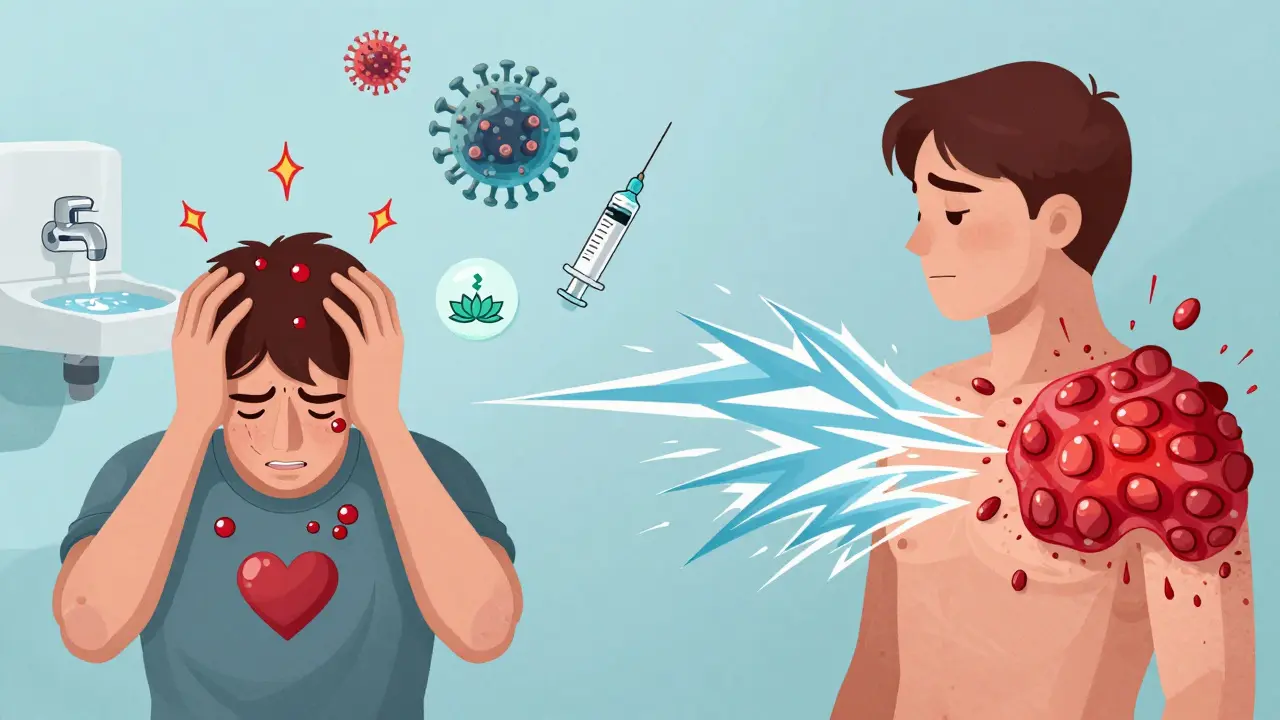
Broken Skin Barrier: The Silent Catalyst
Think of your skin like a brick wall. The bricks are skin cells. The mortar is lipids - fats that hold everything together and keep moisture in. In psoriasis, this wall cracks. When it does, water escapes, irritants get in, and bacteria move in. That’s when flares begin. The PMC review (2024) calls this the "cycle from barrier destruction to microbiota disturbance, then to lesion aggravation." In mice studies, scientists found that when the skin barrier was damaged, bacteria multiplied and triggered IL-17 and IL-22 - the same chemicals that cause psoriasis plaques. Applying topical antibiotics reduced the inflammation. That’s how tightly linked skin health is to immune response. Even small injuries can spark this. A bug bite, sunburn, scratch, or razor nick can trigger the Koebner phenomenon - where psoriasis forms exactly where the skin was injured. Sanford Dermatology’s data shows 45% of new plaques start at sites of unnoticed trauma. So how do you fix it? Moisturizing isn’t enough if you’re using the wrong product. The American Academy of Dermatology recommends fragrance-free moisturizers with ceramides - the exact lipids your skin is missing. Apply twice daily, especially after showering. Avoid soaps with a pH above 5.5; they strip your skin’s natural protection. Keep indoor humidity between 40-60%. In dry climates, use a humidifier. Skip hot showers - they dry out skin faster than cold ones.What Else Can Trigger Psoriasis? (And What Doesn’t)
You’ve probably heard that gluten, dairy, or sugar causes psoriasis. Some people swear by it. But here’s the truth: while diet can play a role, it’s not universal. A 2022 National Psoriasis Foundation survey of 1,247 patients found that only 32% reported dairy as a trigger, 25% said gluten, and 18% pointed to nightshades. That means 68% of people saw no change after cutting out dairy. Smoking and alcohol? Yes - they worsen psoriasis. Smoking doubles the risk of developing it. Heavy drinking interferes with medication and increases inflammation. Obesity? Fat tissue releases inflammatory chemicals. Losing even 5-10% of body weight can improve symptoms. Weather matters too. Cold, dry air dries out skin and triggers 68% of patients. Hot, humid weather helps 72%. But 8% have photosensitive psoriasis - sun makes it worse. So don’t assume sunlight is always good. Medications like beta-blockers, lithium, or antimalarials can also trigger flares. If you notice a flare after starting a new drug, talk to your doctor. Don’t stop it yourself.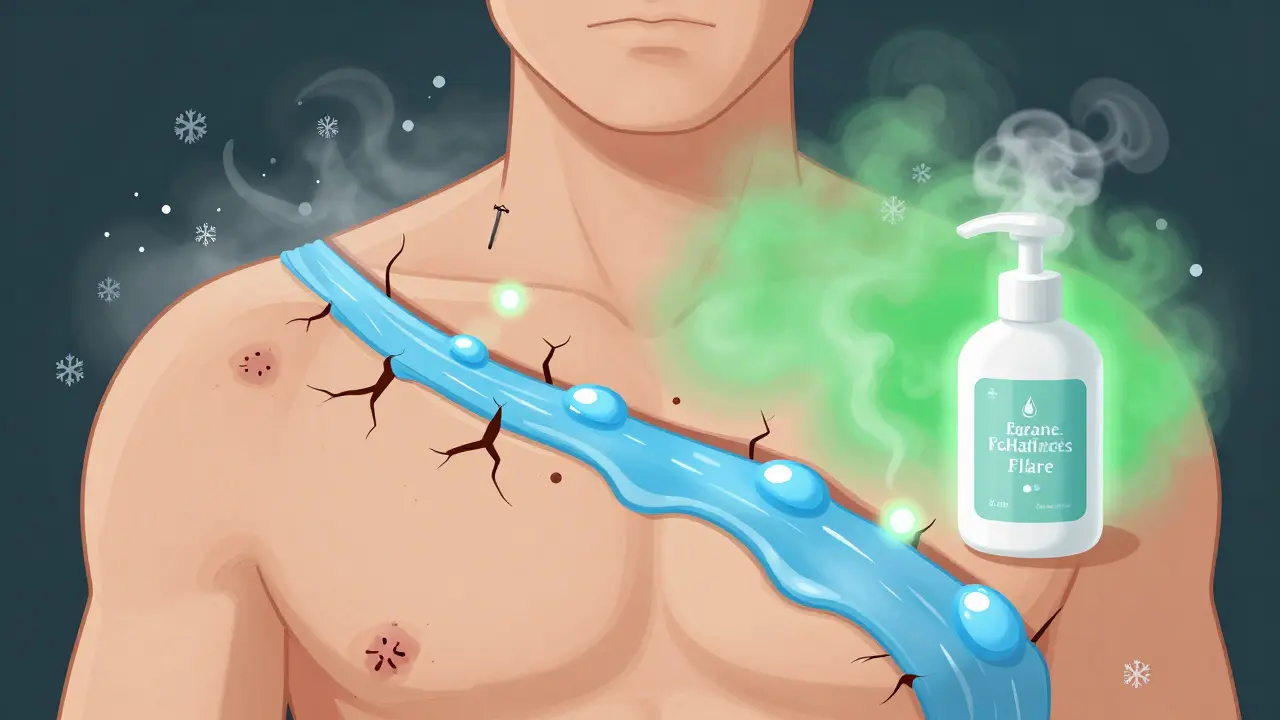
Putting It All Together: A Realistic Plan
There’s no magic cure. But you can break the cycle. Here’s how:- Stress: Add 20 minutes of mindfulness or walking to your day. Therapy works. Journaling helps. Don’t wait until you’re overwhelmed.
- Infection: Wash hands. Get your flu shot. Treat sore throats fast. Don’t ignore a lingering cough or fever.
- Barrier: Use ceramide moisturizer twice daily. Switch to pH-balanced cleansers. Humidify your bedroom. Avoid hot showers.
- Track: Keep a simple log: date, flare severity, stress level, recent illness, skincare changes. Patterns will show up in 4-6 weeks.
What’s Next? The Future of Trigger Management
Researchers are moving fast. A new IL-23 inhibitor drug showed 89% of patients achieved 90% skin clearance in 16 weeks. Probiotics reduced flares by 22% in early trials. Wearable stress monitors and AI symptom trackers are being tested - and could become standard care by 2030. But none of that matters if you don’t control the basics. You don’t need a high-tech gadget to manage psoriasis. You need consistency. You need to treat your skin like a fragile, living system - not something to scrub and ignore.Can stress cause psoriasis, or just make it worse?
Stress doesn’t cause psoriasis on its own - you need a genetic predisposition. But it can trigger the first flare in someone who’s genetically at risk. Once psoriasis is present, stress makes flares more frequent and severe by activating inflammatory pathways. The relationship is bidirectional: psoriasis causes stress, and stress worsens psoriasis.
Do I need to avoid all infections to prevent psoriasis flares?
No - you don’t need to live in isolation. But you should take smart precautions: get vaccinated (flu, pneumonia, COVID-19), wash your hands regularly, and treat infections like strep throat or sinusitis promptly. Even minor infections can trigger flares in susceptible people, especially those with guttate psoriasis. Prevention is key, not avoidance.
What moisturizer ingredients should I look for?
Look for ceramides, hyaluronic acid, glycerin, and petrolatum. Avoid fragrances, alcohol, sulfates, and parabens. Ceramides are especially important - they rebuild the skin’s natural barrier. Use them twice daily, right after showering while skin is still damp. Brands like CeraVe, Eucerin, and Vanicream are dermatologist-recommended for psoriasis.
Can psoriasis flares be prevented entirely?
Not always - psoriasis is a chronic condition. But you can drastically reduce flare frequency and severity. Patients who manage stress, prevent infections, and protect their skin barrier report 50-70% fewer flares. Consistency matters more than perfection. Even small daily habits make a big difference over time.
Is psoriasis contagious?
No. Psoriasis is an autoimmune disease, not an infection. You can’t catch it from touching someone, sharing towels, or being near them. The plaques may look scary, but they’re not infectious. Misunderstanding this often leads to stigma - which itself can become a stress trigger.
March 14, 2026 AT 01:23 AM
OMG this post hit SO hard 😭 I’ve been dealing with psoriasis since college, and stress? My entire life is one big cortisol storm. 🧠💥 But once I started using ceramide creams + 10-min breathwork before bed? Game. Changer. 🙌 Also-yes to the flu shot. Got one last October. Zero flares since. 🤞 #PsoriasisWarrior
March 15, 2026 AT 21:16 PM
It’s rather elementary, isn’t it? The notion that psoriasis is merely a dermatological phenomenon betrays a fundamental misunderstanding of immunological homeostasis. One must recognize that cytokine dysregulation-specifically IL-23/Th17 axis activation-is not triggered by ‘stress’ per se, but by upstream neuroendocrine perturbations mediated via the HPA axis. The cited Mount Sinai data is, frankly, correlational at best.
And yet, the suggestion that ‘mindfulness’ mitigates inflammation? A charmingly naive reductionism. One cannot ‘meditate’ one’s way out of genetic predisposition. The real solution lies in biologics, not breathing exercises.
March 16, 2026 AT 17:52 PM
While the article presents a comprehensive overview, I must emphasize the necessity of empirical validation in clinical recommendations. The assertion that 78% of patients correlate stress with flares relies on self-reported data, which introduces significant recall bias. Furthermore, the efficacy of mindfulness interventions has not been robustly replicated in randomized controlled trials with sufficient statistical power.
It is imperative that therapeutic guidance be anchored in peer-reviewed, longitudinal studies rather than anecdotal Reddit testimonials. The burden of proof remains unmet in this context.
March 18, 2026 AT 17:28 PM
Y’all. I’m not a doctor. But I’ve had psoriasis for 17 years. And let me tell you-this post? It’s the first time someone got it RIGHT. 🙏
Stress? I lost my job. Flare covered my neck. I cried in the shower. Then I started walking 20 mins every morning. No music. Just me and my breath. Six weeks later? My elbows looked like skin again.
Infection? I got a cold last winter. Didn’t treat it. Boom-guttate all over my arms. Flu shot this year? Zero. Zero. Zero.
Moisturizer? I used CeraVe. Every. Single. Night. Even when I was too tired to care. That’s the secret. Not magic. Just consistency.
You’re not broken. You’re just overworked. And your skin? It’s begging you to slow down. Listen to it. ❤️
March 20, 2026 AT 17:19 PM
So let me get this straight-you’re telling me we should all be doing yoga and washing our hands to fix a genetic autoimmune disorder? Meanwhile, real medicine has IL-23 inhibitors that clear 90% of plaques in 16 weeks. This post reads like a wellness blog written by someone who’s never met a real dermatologist.
Stop glorifying ‘mindfulness’ as a cure. It’s not. It’s a distraction. Focus on the science. Take your meds. Stop the pseudoscience.
March 21, 2026 AT 21:53 PM
What’s interesting here is the epistemological tension: we’re told to treat psoriasis as a system, yet the medical model still treats it as a symptom. Stress, infection, barrier dysfunction-they’re not ‘triggers.’ They’re *manifestations* of a deeper immune dysregulation. The body isn’t malfunctioning. It’s communicating.
And yet, we’re offered bandaids: ceramides, humidifiers, flu shots. All useful. All superficial. We need to ask: why does the immune system turn on itself? What ancestral, environmental, or epigenetic rupture caused this?
The answer isn’t in the skin. It’s in the soil, the diet, the trauma, the silence. We’re treating the echo, not the scream.
March 22, 2026 AT 23:33 PM
I’ve been a dermatology nurse for 12 years. This article is accurate. Not perfect-but accurate.
People think psoriasis is just dry skin. It’s not. It’s an immune fire. And yes-stress, infections, and broken barriers are the three main kindling sources.
One thing I always tell patients: You don’t need to be perfect. You just need to be consistent. One moisturizer. One walk. One hand wash. One night of sleep. Do that every day. Not because it’s trendy. Because it works.
And no-you don’t need to buy expensive products. CeraVe costs $12. It’s all you need.
March 23, 2026 AT 01:01 AM
Did you know the CDC has quietly admitted that psoriasis flares spiked after the 2020 lockdowns? Coincidence? I think not. The flu shot? It contains adjuvants that trigger TLR-7 activation. The ‘ceramide moisturizers’? Most are made by Big Pharma subsidiaries. And mindfulness? It’s just a distraction tactic to keep you docile while the real causes-EMFs, glyphosate, 5G-are ignored.
Wake up. This isn’t science. It’s a manufactured narrative. The real cure? Get off the grid. Go live in the woods. No internet. No vaccines. No soap. Just nature. That’s the truth they don’t want you to know.
March 24, 2026 AT 07:10 AM
Oh. My. GOSH. I just finished reading this, and I am literally in tears-TEARS, I tell you! 🥹💔
After three years of relentless, agonizing, soul-crushing plaques-after being told by three different specialists that "it’s just stress"-I finally, FINALLY feel SEEN. 🌟
That paragraph about the skin barrier being a "brick wall"? That’s EXACTLY how I visualize it-except mine’s been demolished by a bulldozer named "life."
And the fact that you mentioned Koebner phenomenon? I got mine from a mosquito bite last summer. I swear, I still have the scar. It’s like my skin remembers. 🤯
So I’m starting tomorrow: ceramide cream. 20 minutes of journaling. Flu shot. And I’m quitting my job. No, seriously. I am. My skin is worth more than a paycheck.
Thank you. From the bottom of my heart. I’m not alone anymore. 🙌💕