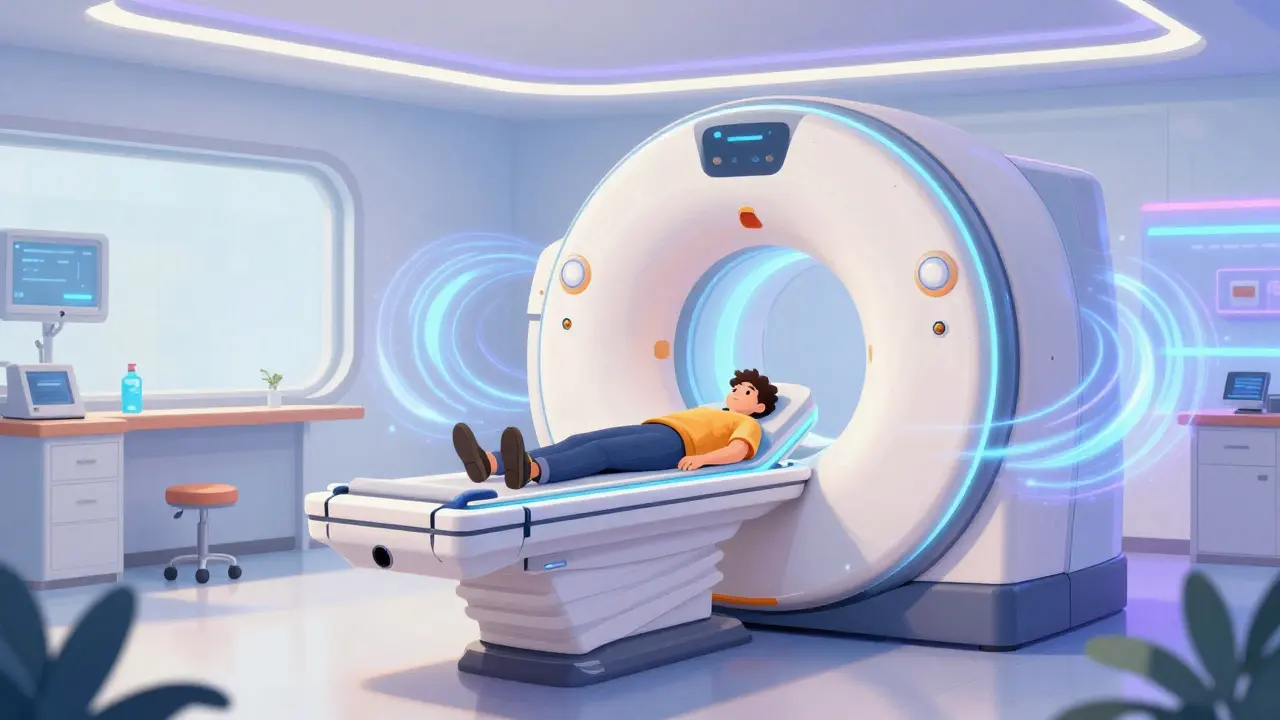
The Core Technology: How It Works
Most clinical settings use magnets with strengths of 1.5T or 3.0T. That "T" stands for Tesla, a unit of magnetic field strength. A 3.0T magnet is roughly 40% better at picking up signals than a 1.5T one, allowing doctors to see tiny structures like the cranial nerves with much higher clarity. Because MRI relies on magnets, it isn't for everyone. If you have a pacemaker or certain cochlear implants, the machine is a no-go. It also takes a while-usually 30 to 45 minutes-which is why it isn't the first choice for a patient in the middle of a traumatic accident. For those situations, speed is everything, and CT wins. But for a deep dive into the brain's architecture, the MRI is unmatched.Decoding the "Settings": MRI Sequences Explained
Think of an MRI sequence as a filter on a camera. Depending on which filter the technician uses, different things will light up.- T1-Weighted: This is the "anatomy scan." Fat looks bright, and water-based fluids like cerebrospinal fluid (CSF) look dark. It's perfect for seeing the actual shape and structure of the brain.
- T2-Weighted: Here, water looks bright. Since most brain pathologies-like inflammation or tumors-contain a lot of water (edema), they stand out clearly against the darker brain tissue.
- FLAIR (Fluid-Attenuated Inversion Recovery): This is a modified T2 scan. It tells the machine to "ignore" the normal fluid in the ventricles so that only the abnormal fluid (like the plaques found in multiple sclerosis) stays bright.
- DWI (Diffusion-Weighted Imaging): This is the emergency sequence. It detects restricted water movement. If a stroke happens, DWI can spot the damage within 30 minutes, whereas a CT might not see it for a full day.
- SWI (Susceptibility-Weighted Imaging): This is the "blood detector." It is incredibly sensitive to iron and blood products, making it the go-to for finding tiny microhemorrhages.
| Sequence | What looks bright? | Best for detecting... |
|---|---|---|
| T1 | Fat / Contrast | Anatomy and Structure |
| T2 | Water / Fluid | Edema and Inflammation |
| FLAIR | Pathological Fluid | MS Plaques, Periventricular lesions |
| DWI | Restricted Water | Acute Ischemic Stroke |
| SWI | Blood/Iron | Microbleeds and Hemorrhage |

Common Findings and What They Mean
When a radiologist looks at your images, they follow a specific path-usually starting at the midline and moving outward. They aren't just looking for "spots," but for patterns.For example, if they see bright spots on a FLAIR image in the temporal lobe, it might suggest something like herpes encephalitis. If those same spots are concentrated in the parietal-occipital region, it points toward a different condition called posterior reversible encephalopathy syndrome. This is why the location of the finding is often more important than the finding itself.
Another common area of focus is the Cerebellopontine Angle, a small space where the brainstem meets the cerebellum. Radiologists check this area in almost every patient because it is where small, often benign tumors called vestibular schwannomas can hide. An MRI can find these when they are as small as 2mm-far too small for a CT to reliably catch.MRI vs. CT: Which One is Better?
It is not a matter of one being "better," but rather which tool is right for the job. If you are in the ER with a suspected stroke, a CT Scan is the first choice because it takes five minutes and can immediately rule out a massive brain bleed. If the doctor sees no bleed, they can safely give you clot-busting medication. However, if the goal is to differentiate between gray matter and white matter, MRI is roughly 100 times more precise. While a CT might only show 4 or 5 distinct shades of tissue, an MRI can show 30 to 40. This high contrast is what allows doctors to spot the subtle "fingerprints" of dementia or the early stages of an autoimmune attack on the nervous system.
The Future of Neuroimaging
We are moving past the era of just looking at "pictures." The next generation of imaging is quantitative. Instead of a doctor saying, "The brain looks a bit shrunken," they will use AI-driven software like Quantib to measure exactly how much brain volume has been lost compared to a healthy person of the same age. There are also ultra-high field 7.0T magnets. These are currently found in a few elite academic centers and can image the brain with 0.5mm resolution. This allows scientists to see individual cortical layers, which was previously impossible. We are also seeing the rise of Diffusion Tensor Imaging (DTI), which allows doctors to map the "wiring" of the brain (white matter tracts) in 3D, helping surgeons avoid critical nerve paths during tumor removal.Is a brain MRI safe?
Yes, for most people. Because it uses magnetic fields rather than radiation, there is no risk of DNA damage. The primary risk is for people with metal implants, such as certain pacemakers or shrapnel, which can be moved or heated by the magnet. Always disclose all metal implants to your technician.
Why did my doctor order an MRI instead of a CT?
Your doctor likely needs to see soft tissue detail. MRI is significantly better at visualizing the posterior fossa (the back of the brain), detecting MS plaques, and identifying early ischemic strokes. If the issue is a suspected tumor or a chronic neurological disease, MRI is the gold standard.
What does "contrast" mean in an MRI report?
Contrast is a dye (usually gadolinium) injected into your vein. It leaks into areas where the blood-brain barrier is damaged, such as in active inflammation or tumors. It makes these "leaky" areas light up, helping doctors tell the difference between an old, inactive scar and a new, active lesion.
How long does it take to get results?
The scan itself takes 30-45 minutes, but the interpretation takes longer. A neuroradiologist must systematically review hundreds of image slices. Depending on the facility, a final report usually takes anywhere from a few hours (in emergencies) to several business days.
Can an MRI diagnose Alzheimer's?
An MRI cannot "diagnose" Alzheimer's on its own, but it can show characteristic atrophy (shrinkage) in the hippocampus. When combined with clinical tests and newer techniques like amyloid PET/MRI fusion, it becomes a critical part of the diagnostic process.