

When you’re pregnant or breastfeeding and have asthma, the last thing you want to do is risk your baby’s health. But here’s the hard truth: asthma medication is often safer than not taking it. Many women stop their inhalers out of fear - and that’s when things get dangerous. Uncontrolled asthma during pregnancy increases the risk of preterm birth, low birth weight, and even preeclampsia. The same goes for breastfeeding: if your asthma flares up, you’re not getting enough oxygen - and neither is your baby.
Why Asthma Gets Worse During Pregnancy
It’s not just in your head. About one in three pregnant women with asthma notice their symptoms get worse, especially between weeks 24 and 36. Why? Hormones shift. Your body holds more fluid. Your growing uterus pushes up on your diaphragm. All of this makes breathing harder - even if your asthma was mild before. And here’s the catch: shortness of breath in late pregnancy? That’s normal. It doesn’t mean your asthma is out of control. But if you’re wheezing, coughing at night, or needing your rescue inhaler more than twice a week, that’s a red flag.The Safest Asthma Medications for Pregnancy
The gold standard? Inhaled corticosteroids (ICS). These aren’t the same as oral steroids you might think of. Inhaled versions like budesonide (Pulmicort) deliver the drug straight to your lungs. Only 10-30% of the dose even gets into your bloodstream. The rest? You breathe it out. Over 10,000 pregnancy cases have been tracked, and budesonide shows no increased risk of birth defects. It’s the most studied and recommended first-line treatment.Short-acting beta agonists (SABAs) like albuterol (Ventolin) are your rescue inhaler. Used as needed, they’re perfectly safe. A 2022 review by National Jewish Health found no rise in congenital malformations even at standard doses. You can use them before exercise, during a flare, or at night - no need to hold off.
Long-acting controllers like salmeterol or formoterol? Also safe. The American College of Obstetricians and Gynecologists says keeping asthma stable with daily medication is better than risking a flare. If you were on one before pregnancy, keep it. Don’t switch unless your doctor says so.
What About Leukotriene Modifiers and Biologics?
Montelukast (Singulair) is an oral pill some women take. Data is limited, but studies so far haven’t shown harm. The Breastfeeding Network says the amount that ends up in breast milk is far lower than what’s given to infants over six months. Still, if you can use an inhaler instead, go for it. Inhaled = less systemic exposure.Biologics like omalizumab (Xolair) are newer. They’re great for severe asthma, but there’s not enough data on pregnancy outcomes yet. The FDA still lists them as Category B, meaning no proven risk in animals - but human data is thin. Most doctors won’t start them during pregnancy, but if you were already on one, they usually advise continuing. The same goes for newer options like dupilumab. Don’t stop without talking to your specialist.
Asthma Medications and Breastfeeding
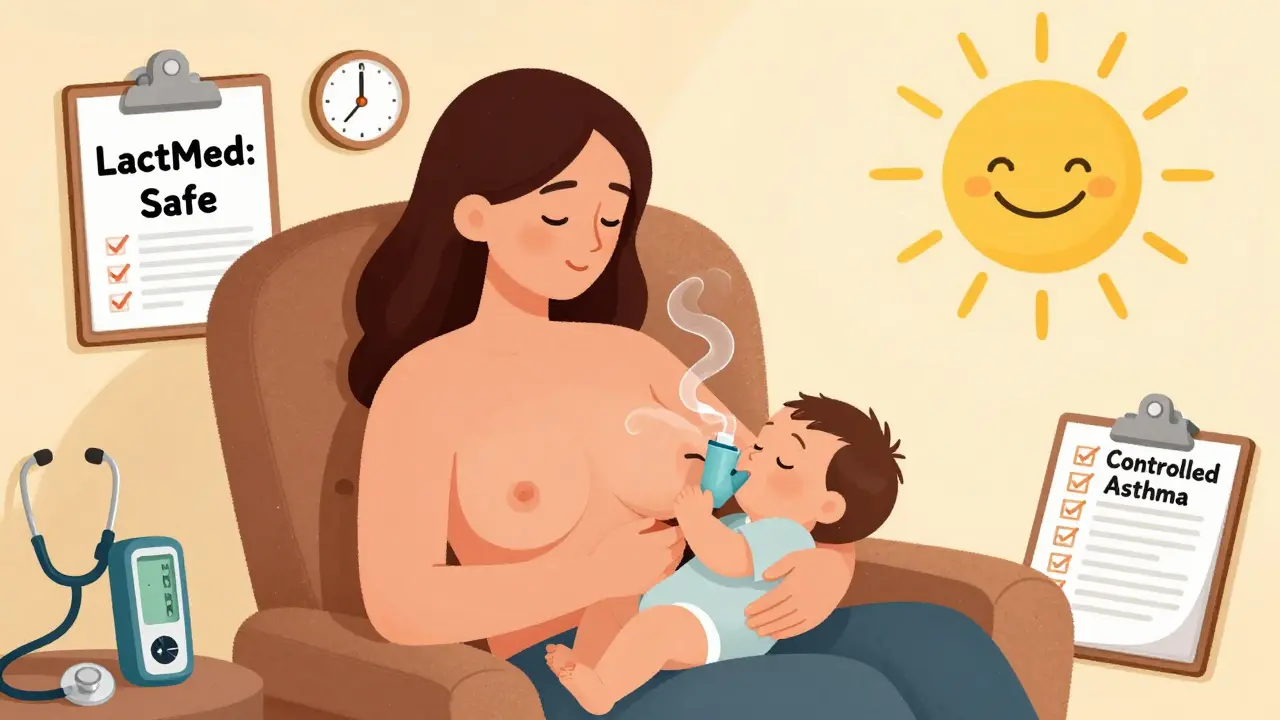
Here’s the good news: almost all asthma inhalers are safe while breastfeeding. Why? The amount of drug that enters your bloodstream is tiny. What little gets there? Even less goes into breast milk.Take budesonide again. Less than 0.1% of the dose shows up in milk. Albuterol? Nearly undetectable. The Breastfeeding Network says: "Inhalers do not produce levels of drug in the blood system let alone in milk." So no need to time your inhaler around feedings. Use it when you need it.
Oral steroids like prednisone? A 40mg daily dose for five days won’t hurt your baby. But if you’re on higher doses long-term, some experts suggest waiting 4 hours after taking it before nursing - just to be extra cautious. The LactMed database confirms this is a low-risk strategy.
Theophylline? It’s older, but still used. Less than 1% of the maternal dose ends up in milk. Still, it needs blood level monitoring because it has a narrow safety window. If you’re on it, stick with your doctor’s check-ups.
What You Should Avoid
Oral medications - especially pills - should be your last resort. Why? They flood your whole system. A 2023 AAAAI guideline says: "Oral medications (pills) should be avoided unless necessary." That includes oral corticosteroids unless you’re having a severe flare. Even then, short courses are better than long ones.Don’t switch to untested herbal remedies. Don’t stop your inhaler because you read a scary post online. And don’t assume "natural" means safe. Pregnancy changes how your body processes everything.
Real Risks - And Real Numbers
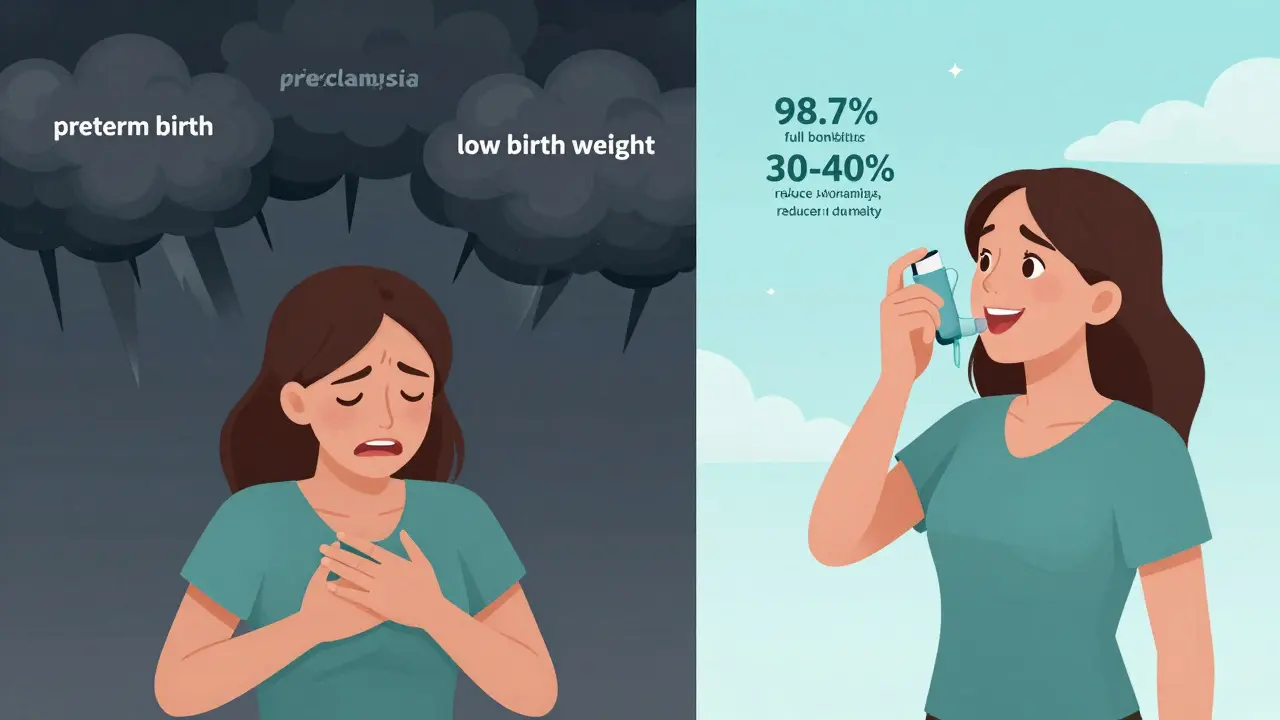
Let’s look at what happens when women stop their meds. A 2021 study in PMC8185876 found 20-25% of pregnant asthmatics quit their medication because of fear. The result? 37% ended up in the ER - compared to just 12% of those who stayed on track. One National Jewish Health case study followed 327 pregnant women using standard asthma regimens. 98.7% delivered at full term with normal birth weights. In the group that skipped meds? Only 76.4% did.Uncontrolled asthma increases the risk of preeclampsia by 40%. Preterm birth? Up by 50%. Low birth weight? Nearly doubled. Meanwhile, studies show that keeping asthma under control reduces fetal and newborn mortality by 30-40%.
What You Should Do Right Now
If you’re planning pregnancy, see your asthma specialist. Get your control on track before conception. If you’re already pregnant, don’t wait. Schedule a check-up. Your doctor should:- Review your current meds and adjust if needed
- Give you a personalized asthma action plan
- Teach you how to use your peak flow meter - target values drop 5-10% in late pregnancy, and that’s normal
- Set up check-ups every 4-6 weeks (not every 6 months)
For breastfeeding moms: keep using your inhaler as usual. No need to pump and dump. No need to time feeds. Just breathe. If you’re worried about a specific drug, ask your pharmacist for the LactMed database summary - it’s free and reliable.
Common Myths Debunked
- Myth: "I can’t use my inhaler - it might hurt the baby." Truth: Not breathing hurts the baby more. Oxygen deprivation is the real danger.
- Myth: "All asthma drugs are dangerous during breastfeeding." Truth: Inhaled drugs have near-zero transfer to milk. Oral drugs? Rarely an issue at normal doses.
- Myth: "Shortness of breath means my asthma is flaring." Truth: 60-70% of pregnant women feel breathless in third trimester - even with perfect asthma control.
What’s Changing in 2026
The NIH just launched a $4.7 million registry in 2024 tracking 5,000 pregnancies to build better safety data - especially for newer biologics. Results will come out around 2027. The American Thoracic Society is also pushing for more lactation pharmacokinetic studies. By 2030, experts expect adherence rates to jump from 75% to 95% thanks to better education and clearer messaging.One thing won’t change: the message from every major medical group - the American Lung Association, ACOG, AAAAI - is the same. "Taking your asthma medicine is safer than having uncontrolled asthma."
Is it safe to use my inhaler during pregnancy?
Yes. Inhaled medications like budesonide and albuterol are among the safest asthma treatments during pregnancy. They deliver the drug directly to your lungs with minimal absorption into your bloodstream. Over 10,000 pregnancy cases have been studied, and no increase in birth defects has been found. Stopping your inhaler puts both you and your baby at greater risk than using it.
Can I breastfeed while using asthma medication?
Absolutely. Inhaled asthma medications transfer almost nothing into breast milk. Less than 0.1% of your dose reaches your baby. There’s no need to time your inhaler around feedings or pump and dump. The Breastfeeding Network and LactMed both confirm these medications are safe. If you’re on oral steroids, occasional short-term use is still considered safe - only very high doses might require a short wait after taking the pill.
What if I’m on a biologic like Xolair or Dupixent?
If you were already using a biologic before pregnancy, most doctors recommend continuing - the risk of uncontrolled asthma is higher than the unknowns about the drug. However, these are not typically started during pregnancy due to limited data. The same applies to breastfeeding: while no harm has been shown, there isn’t enough evidence to say they’re definitively safe. Always consult your allergist or pulmonologist before making changes.
Should I stop my asthma meds if I’m trying to get pregnant?
No. In fact, the opposite. Get your asthma under control before conception. Uncontrolled asthma increases the risk of miscarriage, preeclampsia, and preterm birth. Your doctor can help you switch to the safest medications if needed - like budesonide - and set up a plan for monitoring your lung function during early pregnancy. Stable asthma = better outcomes for both you and your future baby.
Why do some women stop their asthma medication during pregnancy?
Fear. Many women hear stories, read alarming posts online, or worry about "chemicals" affecting their baby. A 2021 study found 20-25% of pregnant women with asthma stopped their meds because of safety concerns. But the data shows the opposite: uncontrolled asthma causes more harm than any approved medication. Doctors now emphasize: "If you can’t breathe, neither can your baby."



March 24, 2026 AT 08:08 AM
So let me get this straight - I’m supposed to trust a pill that says 'safe' on the label but I can’t trust my gut when it screams 'NO'? 🤦♀️ I’ve seen moms on Facebook who took 'safe' meds and their kids had weird rashes. Coincidence? I think not.
March 24, 2026 AT 17:53 PM
I appreciate how data-driven this is. The stats on preterm birth and preeclampsia are hard to ignore. I work in OB/GYN and we’ve seen too many cases where fear led to bad outcomes. This post is a needed counter-narrative.
March 26, 2026 AT 04:50 AM
This is the kind of info we NEED more of!! 🙌 I was terrified to use my inhaler during my pregnancy - now I know I was being irrational. My daughter is 2 and breathing like a champ. Thank you for sharing the science, not the fear. #BreatheEasy
March 26, 2026 AT 10:44 AM
They say 'inhalers are safe'... but who funded the studies? Big Pharma. The FDA approves everything that makes money. You think they care about babies? Nah. They care about profit. My cousin’s kid had seizures after her mom used 'safe' albuterol. They just don’t tell you that part.
March 27, 2026 AT 00:28 AM
This is solid. I’m a nurse and I hand out these exact guidelines to every pregnant patient with asthma. The key is consistency - not stopping. A quick peak flow check every 4 weeks? Game changer. Keep doing this work.
March 27, 2026 AT 11:07 AM
The pharmacokinetic profile of inhaled corticosteroids demonstrates negligible placental transfer. Systemic bioavailability <10%. The risk-benefit calculus is unequivocally favorable. Any deviation from guideline-based management constitutes iatrogenic harm.
March 28, 2026 AT 10:43 AM
Stop lying to pregnant women. You think a puff of chemicals is better than letting nature take its course? My wife had asthma and didn’t use anything. Baby was fine. You’re selling fear to sell pills. Wake up.
March 28, 2026 AT 14:34 PM
omg i just found out my bestie stopped her inhaler bc she read 'meds bad for baby' on a blog and now she’s in the hospital?? like wtf people?? i just wanna cry 😭 this post saved me from making the same mistake
March 28, 2026 AT 20:28 PM
Thank you for this meticulously researched and compassionate overview. As a healthcare provider, I cannot emphasize enough the importance of maintaining asthma control during gestation. The evidence base is robust, and the clinical outcomes are demonstrably superior with appropriate pharmacotherapy.
March 30, 2026 AT 20:39 PM
America is falling apart. We’re medicating everything. My grandma never took pills and had 5 kids. Now we’re scared to breathe. Go back to nature. Stop the fear. Stop the pills.
April 1, 2026 AT 02:58 AM
I wonder… if we stopped treating pregnancy like a medical emergency, would we even need to worry about this? Maybe the real issue isn’t the meds - it’s how we’ve turned a natural process into a risk matrix.
April 1, 2026 AT 09:29 AM
i just read this and im like wow i didnt know that abt the milk thing lol i thought i had to wait 2 hours after my inhaler 😅 my bad
April 1, 2026 AT 10:11 AM
They say 'oxygen deprivation harms the baby'... but what if the baby is already carrying trauma from the mother’s fear? What if the chemicals, even in tiny amounts, imprint on the soul? We’re not just bodies. We’re energy. And energy remembers.
April 1, 2026 AT 15:59 PM
The real tragedy isn’t the fear of medication - it’s the silence around maternal health. We don’t talk about how pregnancy changes your lungs. We don’t train OBs to work with pulmonologists. We just hand out pamphlets and hope for the best. This post? It’s a start.